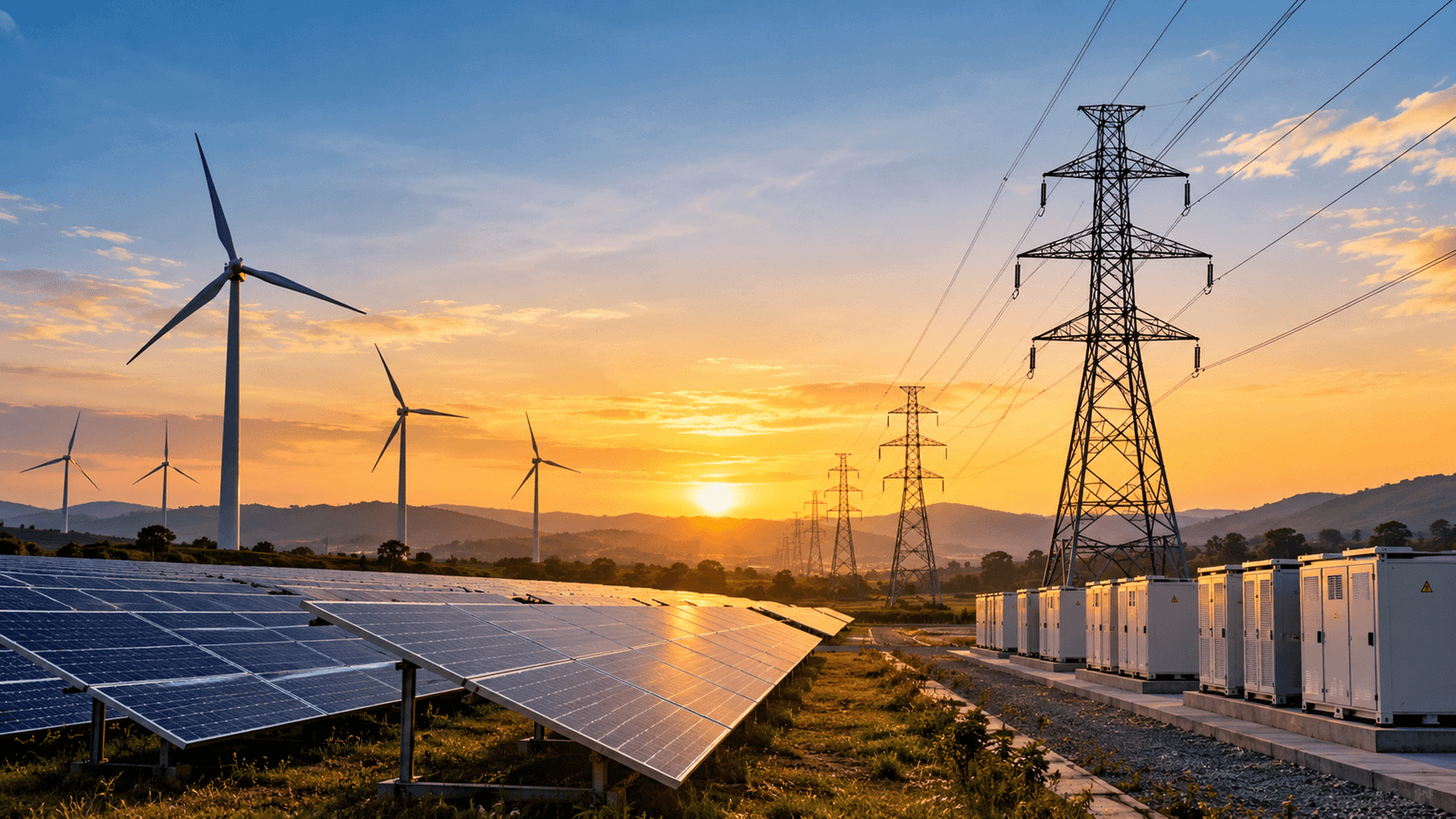
The Union Cabinet has approved the Green Energy Corridor Phase III (GEC-III) with a total estimated cost of ₹1.864 lakh crore, marking a major step towards strengthening India’s power transmission infrastructure and integrating more renewable energy into the national electricity grid.
The project, approved on September 30, 2026, will focus on developing intra-state transmission infrastructure and battery energy storage systems to support the growing share of solar and wind power in India’s energy mix.
₹1.86 Lakh Crore Investment for Transmission and Storage
Of this, around ₹1,36,378 crore has been allocated for intra-state transmission systems, while ₹50,000 crore has been earmarked for battery energy storage systems with a planned capacity of 50 GWh.
The Centre will provide ₹54,082 crore in Central Financial Support for the project.
The transmission infrastructure developed under GEC-III is expected to facilitate the evacuation of up to 135 GW of renewable energy capacity.
Project to Be Completed by FY 2032-33
The Green Energy Corridor Phase III is scheduled to be implemented through FY 2032-33.
The project is intended to strengthen electricity networks within states with significant renewable energy potential. Better transmission infrastructure will allow power generated from renewable sources to be transported more efficiently to areas where it is needed.
The inclusion of large-scale battery storage is another important feature of the third phase. Storage systems can help balance fluctuations in solar and wind generation and make renewable electricity available when generation from these sources is lower.
Focus on Battery Energy Storage
India’s increasing dependence on renewable energy has also created a need for flexible power-storage capacity. Solar generation, for example, is concentrated during daylight hours, while electricity demand continues into the evening.
The planned 50 GWh battery energy storage capacity under GEC-III is expected to help address this challenge. Energy storage can support grid stability, reduce renewable-energy curtailment and improve the availability of electricity during periods when renewable generation falls.
Supporting India’s Renewable Energy Expansion
The government has been expanding transmission infrastructure alongside renewable-energy capacity as part of India’s broader energy-transition strategy.
GEC-III is designed to support the integration of additional non-fossil power capacity and strengthen the country’s electricity grid as renewable generation expands.
The project therefore represents not only an investment in transmission lines but also in the supporting infrastructure needed to make a larger renewable-energy system more reliable.
What Green Energy Corridor Phase III Means for India
The approval of GEC-III comes as India continues to expand solar and wind power capacity. A stronger transmission network will be essential for connecting renewable-energy projects with demand centres, while battery storage can provide greater flexibility to the grid.
With an overall investment of ₹1.864 lakh crore, the project is set to become a significant component of India’s renewable-energy and power-transmission infrastructure over the coming years.
The government expects the combination of expanded transmission capacity and battery storage to help India integrate more renewable electricity while improving the reliability and flexibility of the power grid.