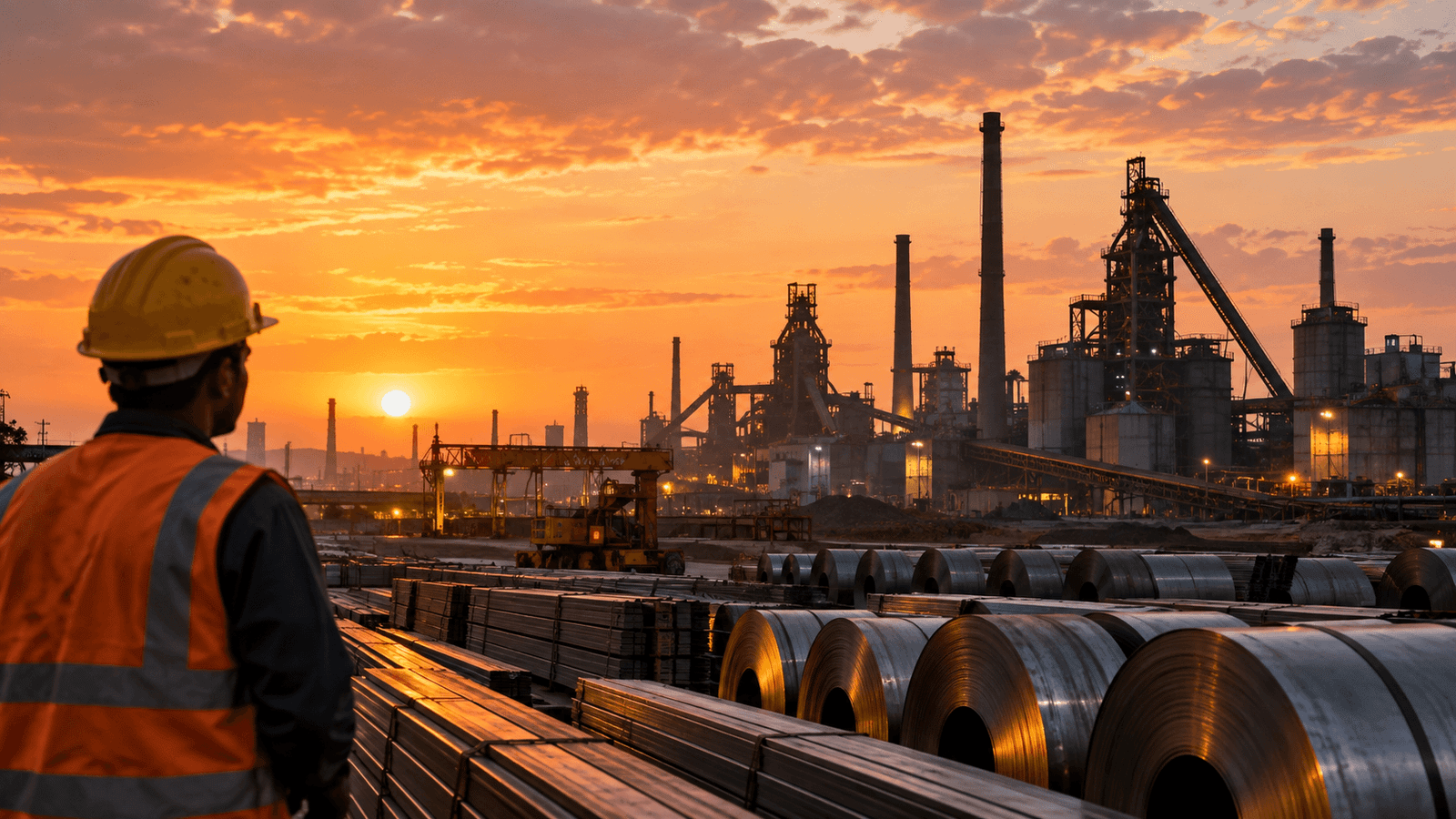
New Delhi: India is planning to raise its steelmaking capacity to 600 million tonnes (MT) by 2047 under a proposed long-term steel policy that is expected to focus on capacity expansion, raw-material security, decarbonisation and the competitiveness of the domestic steel industry.
The proposed roadmap would take India’s crude steel capacity from around 220 MT in 2025-26 to 300 MT by 2030-31, 400 MT by 2035-36 and eventually 600 MT by 2047. The 300 MT and 400 MT milestones have already been identified by the Ministry of Steel as part of its medium-term expansion plans, while the 600 MT target is part of the new long-term policy being prepared by the government.
Why 600 MT?
The proposed 600 MT capacity target comes against a backdrop of strong projected growth in India’s steel demand.
A 2026 NITI Aayog scenario projects India’s steel consumption to rise from 127 MT in 2023 to about 568 MT by 2047. The same scenario projects steel consumption to reach around 821 MT by 2070. NITI Aayog describes these figures as part of its analytical scenarios for India’s development and net-zero transition rather than as an official steel-policy target.
The projected 568 MT of consumption provides an indication of the potential scale of India’s future steel market. However, steelmaking capacity and steel consumption are not identical measures. Actual production will depend on capacity utilisation, domestic demand, exports, technology and market conditions.
The proposed 600 MT capacity therefore represents a long-term industrial planning ambition designed to accommodate the expected expansion of India’s steel market while retaining scope for exports and changes in production requirements.
Raw-material security to be a key focus
Expanding steel capacity to 600 MT will also require a major increase in the availability of raw materials.
According to details reported on the proposed policy, India’s long-term steel expansion could require around 772 MT of iron ore and 214 MT of coking coal. The government is considering measures including overseas resource acquisitions, joint ventures and diversification of supply sources to strengthen raw-material security.
Coking coal is particularly important because of its role in conventional blast-furnace steelmaking. In January 2026, the government also notified coking coal as a critical and strategic mineral under the Mines and Minerals (Development and Regulation) Act, highlighting its importance for the domestic steel sector.
The government has separately been working to increase domestic coking-coal production. The Ministry of Coal’s Mission Coking Coal has a target of increasing domestic raw coking-coal production to 140 MT by FY2029-30.
Focus on competitiveness and imports
The proposed policy is also expected to address the competitiveness of Indian steel producers amid changing global trade conditions.
Steel Secretary Sandeep Poundrik has indicated that measures relating to trade protection, including safeguards and anti-dumping action against unfair or sub-standard imports, could form part of the policy approach. The government is simultaneously seeking greater technological efficiency and competitiveness across the domestic industry, including smaller producers.
India has already introduced several measures aimed at supporting domestic steel producers. These include the Production Linked Incentive (PLI) scheme for specialty steel, import monitoring through the Steel Import Monitoring System and Quality Control Orders intended to prevent sub-standard steel products from entering the domestic market.
Decarbonisation is part of the 2047 roadmap
The expansion of steel capacity is also being planned alongside efforts to reduce the industry’s carbon intensity.
The proposed long-term policy reportedly targets a reduction in average steel-sector emissions intensity from approximately 2.54 tonnes of CO₂ per tonne of crude steel to 1.54 tonnes by 2047. The objective is linked to India’s broader transition towards a lower-carbon economy and its national net-zero emissions target for 2070.
The Ministry of Steel’s existing “Greening the Steel Sector in India: Roadmap and Action Plan”, released in 2024, identifies several pathways for reducing emissions. These include energy efficiency, renewable energy, green hydrogen, material efficiency, process transition, carbon capture, utilisation and storage (CCUS), and the use of biochar in steel production.
The ministry has also established a Green Steel Taxonomy. Under the framework, steel with emissions intensity below 1.6 tonnes of CO₂ equivalent per tonne of finished steel qualifies for the highest, five-star green rating.
Greater role for recycling and scrap
Steel recycling is another part of the industry’s longer-term transition.
India’s existing Steel Scrap Recycling Policy, 2019 aims to increase the availability of domestically generated ferrous scrap and encourage organised scrap processing. Government material also identifies recycling as an important route for producing quality steel while reducing dependence on imported scrap and primary raw materials.
NITI Aayog’s long-term industrial scenarios similarly point towards increasing resource efficiency and cleaner production as India’s steel demand grows. A larger role for scrap-based electric-arc-furnace production could become increasingly important as the country develops a more circular steel economy.
India’s steel roadmap towards 2047
The proposed 600 MT target represents the next stage of India’s long-term steel expansion.
The government has already set intermediate capacity ambitions of 300 MT by 2030-31 and 400 MT by 2035-36. The proposed 600 MT target would extend that trajectory towards 2047, while the broader policy framework is expected to address raw-material availability, technology, trade, recycling and emissions alongside capacity expansion.
The final shape of the roadmap will depend on the proposed National Steel Policy and the consultation process before its formal adoption. For India, the challenge will be to expand steel capacity at the required pace while ensuring sufficient raw materials, competitive production costs and a lower-carbon production base.