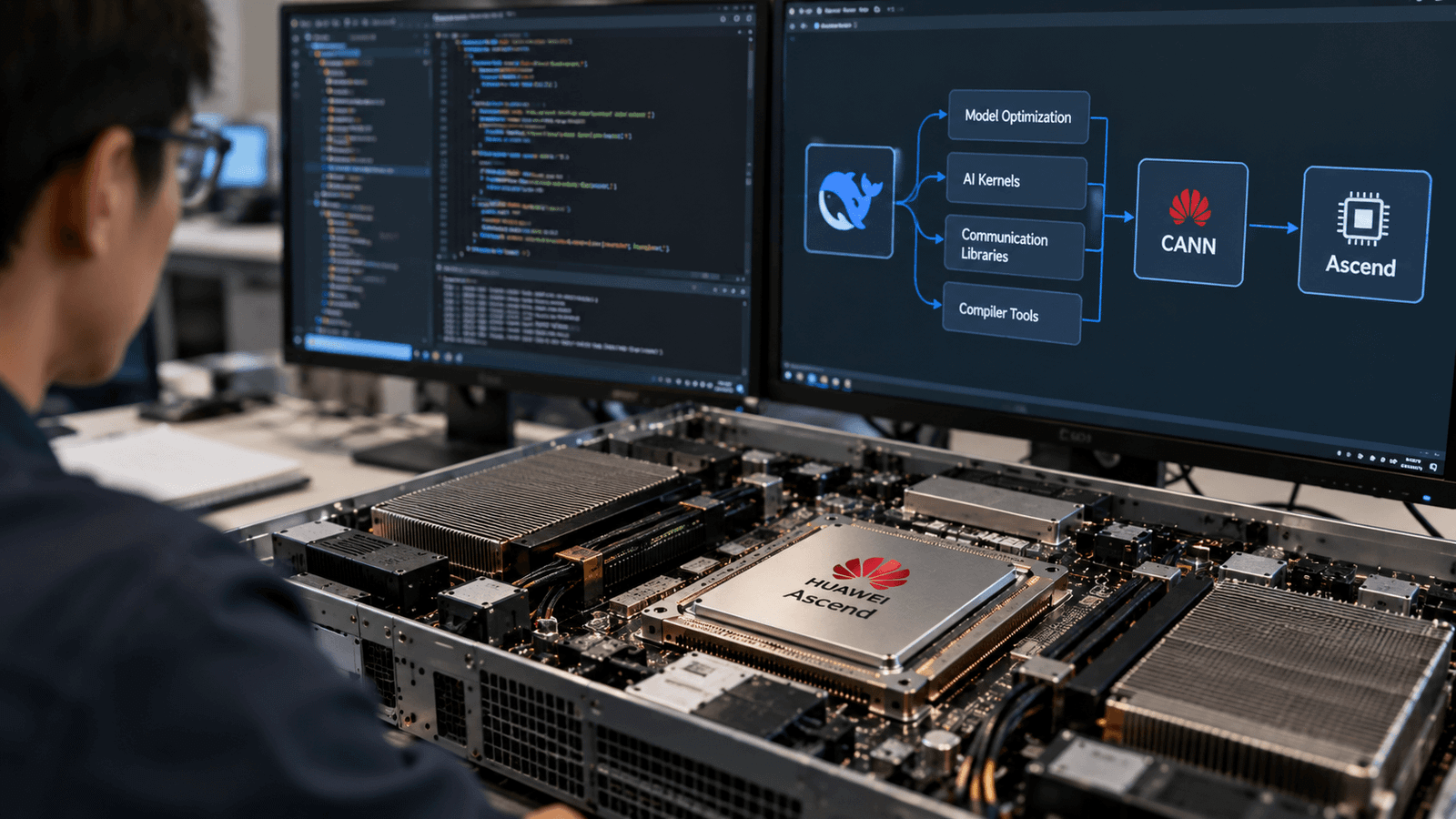
DeepSeek and Huawei are working together to strengthen the software ecosystem around Huawei’s Ascend AI chips, in a move that could make it easier for developers to run and optimize artificial intelligence workloads on Huawei hardware.
The collaboration focuses on software rather than chip design. DeepSeek is contributing AI software, libraries and optimized computing kernels, while Huawei provides its Ascend hardware and underlying software infrastructure.
DeepSeek Brings AI Software Expertise to Ascend
One of the key developments is the work to adapt DeepSeek’s high-performance computing software for Huawei’s Ascend platform.
Among the projects is DeepGEMM-Ascend, an Ascend-focused implementation of DeepSeek’s DeepGEMM technology. The software is designed to accelerate matrix multiplication and other workloads that are important for modern AI models, including mixture-of-experts (MoE) architectures.
The implementation targets Huawei’s newer Ascend processors and supports formats such as BF16, FP8 and FP4, which are increasingly important for efficient AI inference and training.
DeepSeek is also contributing to the use of TileLang, a programming framework designed to make it easier to develop optimized AI kernels across different accelerator architectures.
Huawei’s CANN Software Stack
The DeepSeek collaboration builds on Huawei’s existing Compute Architecture for Neural Networks (CANN) software stack.
CANN provides the software layer that allows AI frameworks and applications to communicate with and take advantage of Ascend processors. Huawei has been expanding CANN and its broader Ascend ecosystem to support popular AI frameworks and open-source projects.
The goal is similar to what Nvidia has achieved with its combination of GPUs, CUDA and a large developer ecosystem: provide developers with the tools needed to efficiently build and run AI applications on a particular hardware platform.
Why the Software Stack Matters
AI accelerator performance is not determined by hardware specifications alone. Developers also need compilers, libraries, optimized kernels and communication software to extract that performance from the chips.
This makes software an important part of the competition between AI accelerator platforms.
By combining DeepSeek’s experience in optimizing large AI models with Huawei’s Ascend hardware and CANN software stack, the companies are attempting to reduce some of the software barriers involved in deploying AI workloads on Ascend chips.
The effort could also make it easier for developers already familiar with open-source AI tools to adapt their workloads to Huawei hardware.
Part of China’s Push for an Alternative AI Computing Ecosystem
The collaboration comes as Chinese technology companies continue developing domestic alternatives to Nvidia’s AI computing ecosystem.
Nvidia has built a major software advantage around CUDA, which gives developers access to a mature collection of libraries and tools for AI workloads. Building a competitive alternative requires more than producing capable chips; it also requires a broad software ecosystem.
Huawei has been investing heavily in Ascend and its associated software stack, while DeepSeek has gained attention for developing highly optimized AI models and infrastructure.
Their collaboration therefore brings together two important pieces of the Chinese AI ecosystem: Huawei’s AI accelerators and infrastructure, and DeepSeek’s expertise in AI software optimization.
The immediate focus is on improving software support and performance for Ascend chips. Over time, the development of more compatible libraries, frameworks and optimized kernels could help expand the number of AI workloads that can run efficiently on Huawei’s platform.