For years, China’s semiconductor ambitions have been defined by one question: Can it build the machines needed to make advanced chips?
This week, that question moved a step closer to an answer.
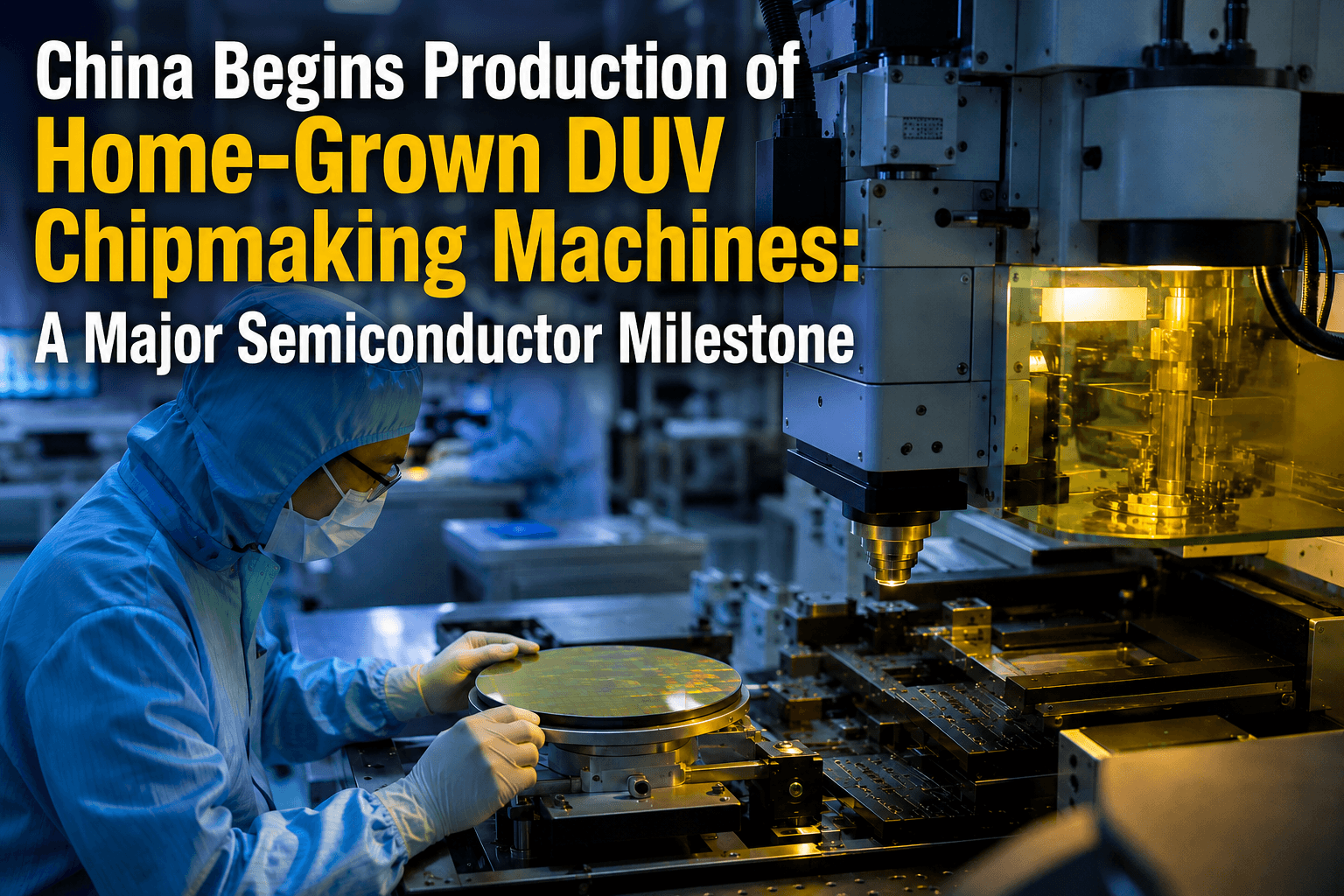
China has begun production of its first domestically developed immersion deep ultraviolet (DUV) lithography systems, according to Reuters, marking a significant milestone in the country’s effort to reduce its dependence on foreign chipmaking equipment. The initial production run is expected to be limited, with deliveries planned for major domestic semiconductor manufacturers, including SMIC, Hua Hong Semiconductor and CXMT.
The announcement does not mean China has matched the world’s leading lithography manufacturers. But it does mark a transition from developing the technology to producing it—a distinction that could prove important over the coming years.
Why Lithography Matters
Modern semiconductor manufacturing depends on an extraordinary piece of engineering: the lithography machine.
These systems project intricate circuit patterns onto silicon wafers, allowing manufacturers to build billions of microscopic transistors that power everything from smartphones and data centers to electric vehicles and artificial intelligence.
Only a handful of companies in the world possess the expertise to manufacture advanced lithography equipment. For the most sophisticated systems, Dutch company ASML has long occupied a unique position in the global semiconductor supply chain.
That concentration became strategically important when export restrictions limited China’s access to the most advanced chipmaking equipment.
From Restrictions to Domestic Development
Over the past several years, the United States and its allies tightened controls on the export of advanced semiconductor technologies to China, arguing that they could have military as well as commercial applications.
Those restrictions extended beyond chips themselves. They also affected the equipment used to manufacture them, particularly advanced lithography systems.
China responded by investing heavily across its semiconductor ecosystem. Support flowed into chip design, manufacturing, materials, memory, packaging and, perhaps most importantly, domestic equipment development.
The start of production for an indigenous immersion DUV lithography system represents one of the clearest outcomes of that strategy so far.
What Has Changed—and What Hasn’t
It is important to separate today’s achievement from what it does not represent.
China has not displaced ASML as the global leader in lithography technology.
Nor does the start of production mean Chinese manufacturers can immediately replace every imported machine. Industry analysts continue to note that China’s systems trail the most advanced international equipment in performance, maturity and production scale.
Execution will now matter as much as engineering. Reliability, manufacturing quality and the ability to deliver these systems consistently will determine whether this becomes a lasting industrial capability.
For now, the significance lies elsewhere.
China is no longer only researching advanced lithography. It has begun manufacturing it.
Why This Matters Beyond China
The semiconductor industry has become one of the world’s most strategically important industries because it sits at the foundation of nearly every modern technology.
Artificial intelligence, cloud computing, telecommunications, defence systems, consumer electronics and advanced manufacturing all depend on increasingly sophisticated chips.
That is why governments now view semiconductor production not only as an economic asset but also as a matter of national capability.
Every new manufacturing technology, production facility or equipment breakthrough therefore carries implications well beyond the companies directly involved.
China’s new lithography systems will not change the global semiconductor landscape overnight.
But they represent something more durable than another investment announcement or research program. They represent the gradual creation of industrial capability.
In recent years, much of the discussion around semiconductors has focused on export controls designed to limit access to critical technologies. This development highlights another side of that story: restrictions can also accelerate efforts to build domestic alternatives.
Whether those alternatives eventually rival the world’s best remains uncertain.
What is becoming increasingly clear, however, is that competition in the semiconductor industry is no longer defined only by who designs the most advanced chips. It is also defined by who can build the tools that make those chips possible.