When AI Became Something Countries Stopped Exporting
For decades, countries treated technology exports much like any other trade.
They sold machines.
Software.
Industrial equipment.
The assumption was simple: if you could build it, you could sell it.
Artificial intelligence is changing that assumption.
China is reportedly considering tighter export controls on advanced AI models, semiconductor technologies, and other strategic AI assets. The discussions include limiting foreign access to model weights, restricting transfers of key training technologies, and tightening oversight of strategic AI companies. The proposals are still under review, but the direction is becoming clear.
This is not just another chapter in the U.S.–China technology rivalry.
It marks a broader shift in how nations are beginning to think about artificial intelligence itself.
The First Phase of the AI Race
The first phase was about building AI.
Countries invested billions into research.
Companies raced to train larger models.
Governments competed to attract talent.
The scarce resource was computing power.
Whoever had the fastest chips had the advantage.
That is why the United States spent years restricting China’s access to advanced semiconductors.
The objective was straightforward: slow China’s ability to train frontier AI systems.
Those export controls were built on the assumption that the critical resource was hardware.
That assumption is now evolving.
AI Is Becoming an Export-Controlled Technology
Once a country develops world-class AI models, the model itself becomes strategically valuable.
Not just the chips.
Not just the data centers.
The intelligence.
An advanced language model can write software, accelerate scientific research, analyze intelligence, improve military planning, and automate knowledge work.
Unlike a physical product, it can also cross borders almost instantly.
A user on another continent can access it within seconds.
That creates a new policy challenge.
How do you prevent strategic technology from leaving the country when it exists primarily as software?
China’s reported discussions suggest that policymakers are beginning to answer that question by treating frontier AI models much like they already treat certain advanced manufacturing technologies or military systems.
The AI Supply Chain Is Expanding
Most people think of AI as a model like ChatGPT or DeepSeek.
In reality, AI depends on an entire supply chain.
It begins with data.
Then comes computing power.
Then algorithms.
Then trained models.
Then model weights.
Then developers who build applications on top.
Each stage has become strategically important.
The first export controls focused on chips because they were the obvious bottleneck.
The next generation of controls may focus on something less visible but equally valuable:
The intelligence embedded inside the models themselves.
The New Strategic Asset
History offers familiar examples.
Oil-producing countries restricted energy exports during periods of geopolitical tension.
Nations have imposed controls on uranium enrichment technologies, advanced aerospace components, and semiconductor manufacturing equipment.
The logic was always the same.
Some technologies are too strategically important to leave entirely to market forces.
Artificial intelligence is beginning to enter that category.
Not because it is merely another software industry.
Because governments increasingly see it as infrastructure.
Infrastructure that shapes economic productivity, military capability, scientific leadership, and national competitiveness.
A Mirror Image
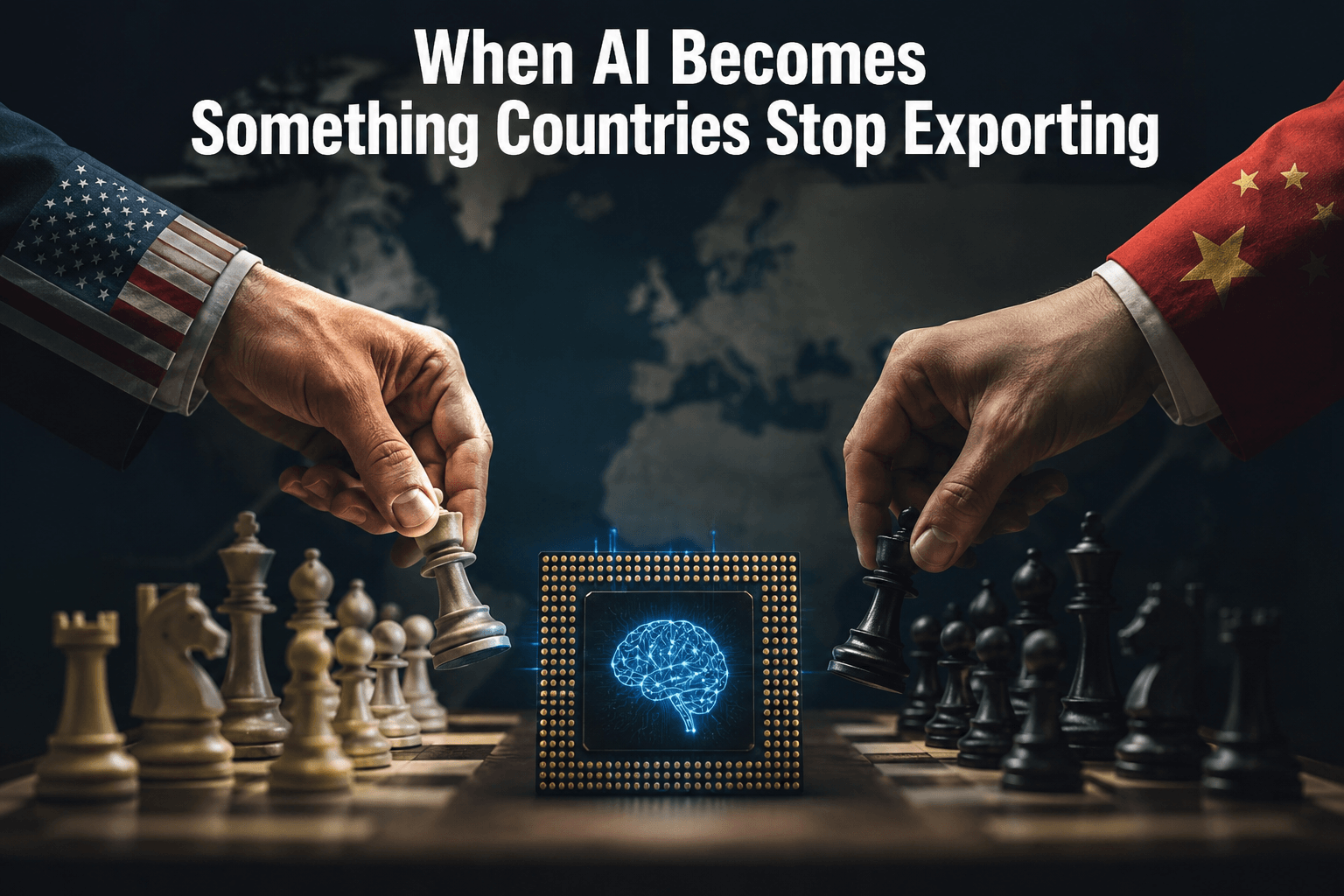
What makes this development particularly significant is that it reflects a change on both sides.
For several years, Washington has tried to prevent advanced American AI technology from strengthening China’s capabilities.
Now Beijing appears to be asking a similar question in reverse.
How much of China’s own AI advantage should remain inside China?
That symmetry tells us something important.
The world’s two largest technology powers are converging on the same conclusion:
Frontier AI is no longer just a commercial product.
It is becoming a strategic national asset.
The Cost of Protection
Restricting exports, however, comes with trade-offs.
Technology companies benefit from global markets.
The more developers who use a model, the faster it improves.
More users generate more applications.
More applications generate more revenue.
More revenue funds better research.
Export controls interrupt that cycle.
Protecting national advantage may reduce global adoption.
Limiting access may strengthen security but weaken commercial scale.
That tension is likely to become one of the defining policy questions of the AI era.
Governments want national champions.
Companies want global customers.
Those goals do not always point in the same direction.
The Bigger Story
It is tempting to see this as another headline in the U.S.–China rivalry.
It is bigger than that.
The twentieth century was shaped by countries controlling physical resources.
Oil.
Steel.
Shipping lanes.
Semiconductors.
The twenty-first century is adding a new category.
Intelligence itself.
The countries that once competed to manufacture technology are beginning to compete over who gets to use it.
That may prove to be the moment artificial intelligence stopped being just another industry—and became part of national strategy.