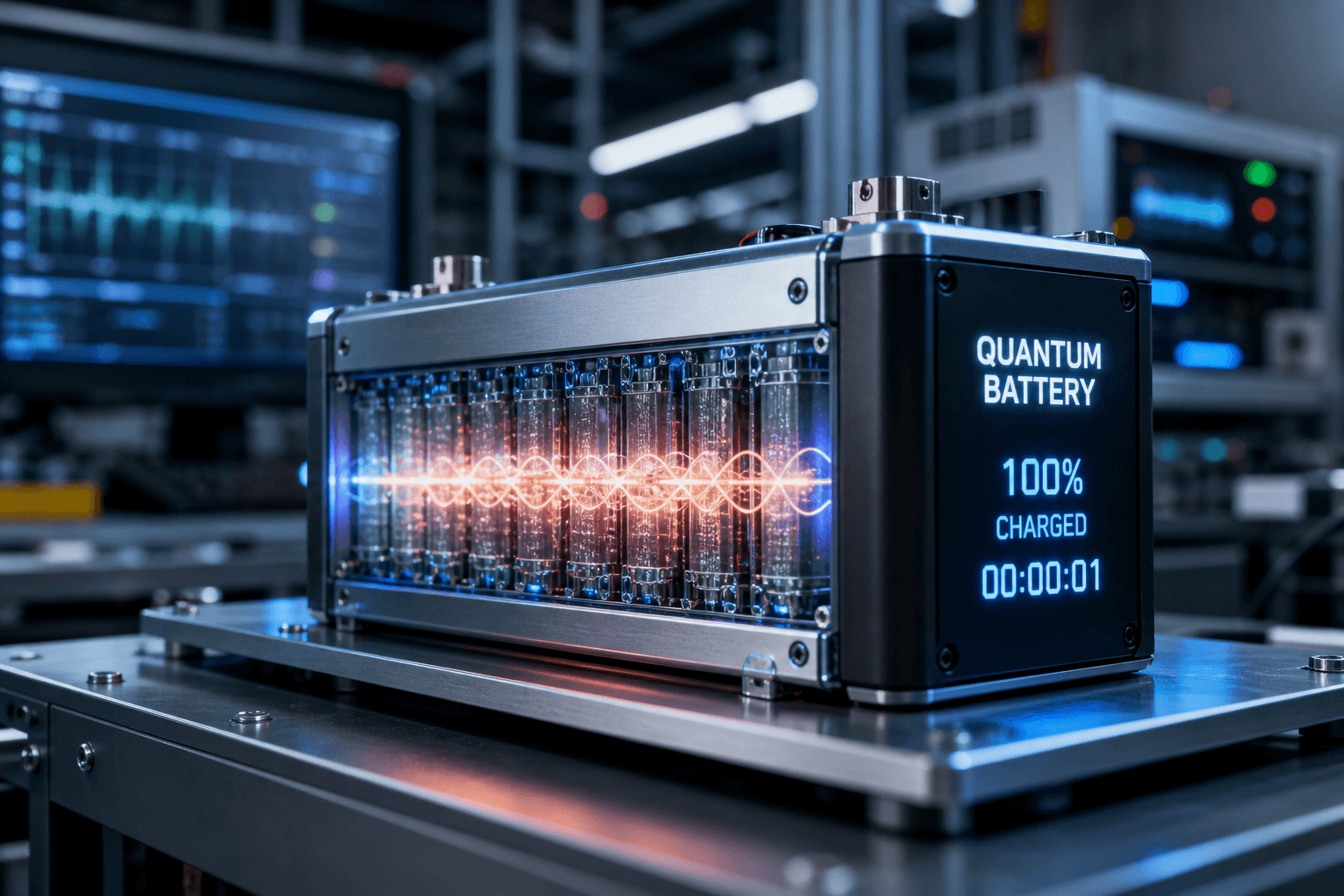
Introduction: Why Quantum Batteries Are Back in the Spotlight
The idea of charging a device in seconds has long sounded like science fiction. But recent advances in quantum batteries—a new class of energy storage systems—are bringing that possibility closer to reality.
The latest surge in attention isn’t due to a single breakthrough. Instead, it reflects a combination of experimental progress, improved system design, and years of foundational work by leading research teams across the globe.
What Are Quantum Batteries and What’s New?
At the center of recent developments is research led by the University of Adelaide, working alongside CSIRO and RMIT University.
Physicist James Quach and collaborators have played a key role in advancing both theory and early-stage prototypes of quantum energy storage systems.
Key Breakthroughs Driving Recent Headlines
Recent research has pushed quantum batteries back into the spotlight through:
- Experimental proof of faster charging using quantum effects
Studies show that quantum systems can charge more efficiently when energy is distributed collectively. - Demonstrations using real quantum hardware
Platforms like superconducting circuits and quantum oscillators are now being used to test these ideas. - Improved efficiency in controlled environments
Early findings suggest reduced energy loss compared to traditional micro-scale systems.
These developments, published in leading journals such as Nature Communications and Physical Review Letters, are helping move the field beyond theory.
Global Progress: A Collective Scientific Effort
Unlike traditional technology launches, quantum battery development is not driven by a single company or announcement.
Where Research Is Happening
- Australia (Adelaide, Melbourne) — leading experimental work
- Europe (Germany, Italy) — advancing quantum thermodynamics
- United States — exploring quantum circuits and applications
This global collaboration has created a momentum shift, making quantum batteries a serious area of innovation rather than a theoretical concept.
Challenges and Scientific Debate
Despite promising results, several challenges remain before quantum batteries become practical:
- Scalability: Current systems operate at very small scales
- Quantum stability (decoherence): Maintaining quantum states is difficult outside lab conditions
- Real-world efficiency: Performance may differ outside controlled environments
These factors continue to fuel debate within the scientific community about how quickly the technology can mature.
Why Quantum Batteries Matter for the Future
If successfully developed, quantum batteries could redefine how we use and store energy.
Potential Applications
- Consumer electronics: Phones and laptops that charge in seconds
- Electric vehicles: Significantly reduced charging times
- Renewable energy: Faster and more efficient energy storage
- Quantum computing: Optimized energy delivery for advanced systems
The impact goes beyond convenience—this technology could reshape energy infrastructure itself.
Broader Context: From Theory to Early Reality
The concept of quantum batteries emerged over a decade ago, based on the idea that quantum entanglement could enable faster energy transfer.
For years, this remained theoretical. Now, experiments—particularly from the University of Adelaide—are validating these predictions in real systems.
At the same time, traditional battery technologies like lithium-ion are approaching their limits, increasing the urgency for next-generation solutions.
Future Outlook: How Close Are We to Instant Charging?
Quantum batteries are still in the early stages, but progress is accelerating.
Short-Term
- Use in quantum devices and specialized systems
Mid-Term
- Hybrid energy systems combining classical and quantum approaches
Long-Term
- Near-instant charging for everyday devices
- More flexible and efficient global energy systems
As investment in quantum technologies grows, the path toward real-world applications is becoming clearer.
Key Takeaways
- Quantum batteries use quantum physics to enable ultra-fast charging
- Recent breakthroughs confirm the concept works in experimental settings
- The University of Adelaide is a key contributor
- Major technical challenges still need to be solved
- The potential impact spans electronics, transport, and energy systems
Conclusion
Quantum batteries are no longer just a theoretical idea—they are entering a phase of real scientific validation.
While widespread adoption may still take time, the progress made so far suggests that near-instant charging is becoming increasingly plausible. As research continues, quantum batteries could play a defining role in the future of energy.