Introduction
For years, Intel was seen as a legacy giant losing relevance in a rapidly evolving chip industry. Manufacturing delays, missed AI opportunities, and aggressive competition had pushed it toward what many considered a slow decline.
That narrative has now flipped.
Intel is not only beating expectations—it is being repositioned as something far more critical: a foundational layer of global technology infrastructure. This shift is being driven by surging AI demand, strategic partnerships, and unprecedented government backing.
AI Demand Is Fueling Intel’s Revival
The explosion of artificial intelligence workloads has created an urgent, almost insatiable demand for advanced chips. Intel is now capitalizing on this wave, aligning its roadmap to meet next-generation AI infrastructure needs.
This surge isn’t isolated to Intel. Across the industry, demand signals are intensifying, with competitors experiencing similar tailwinds, as insatiable AI chip demand continues to reshape the semiconductor industry.
What’s changed is Intel’s positioning—it’s no longer trailing the AI race but actively re-entering it with competitive manufacturing ambitions.
Tesla’s Bet on Intel Signals Market Confidence
A major turning point in Intel’s comeback is its deal with Tesla.
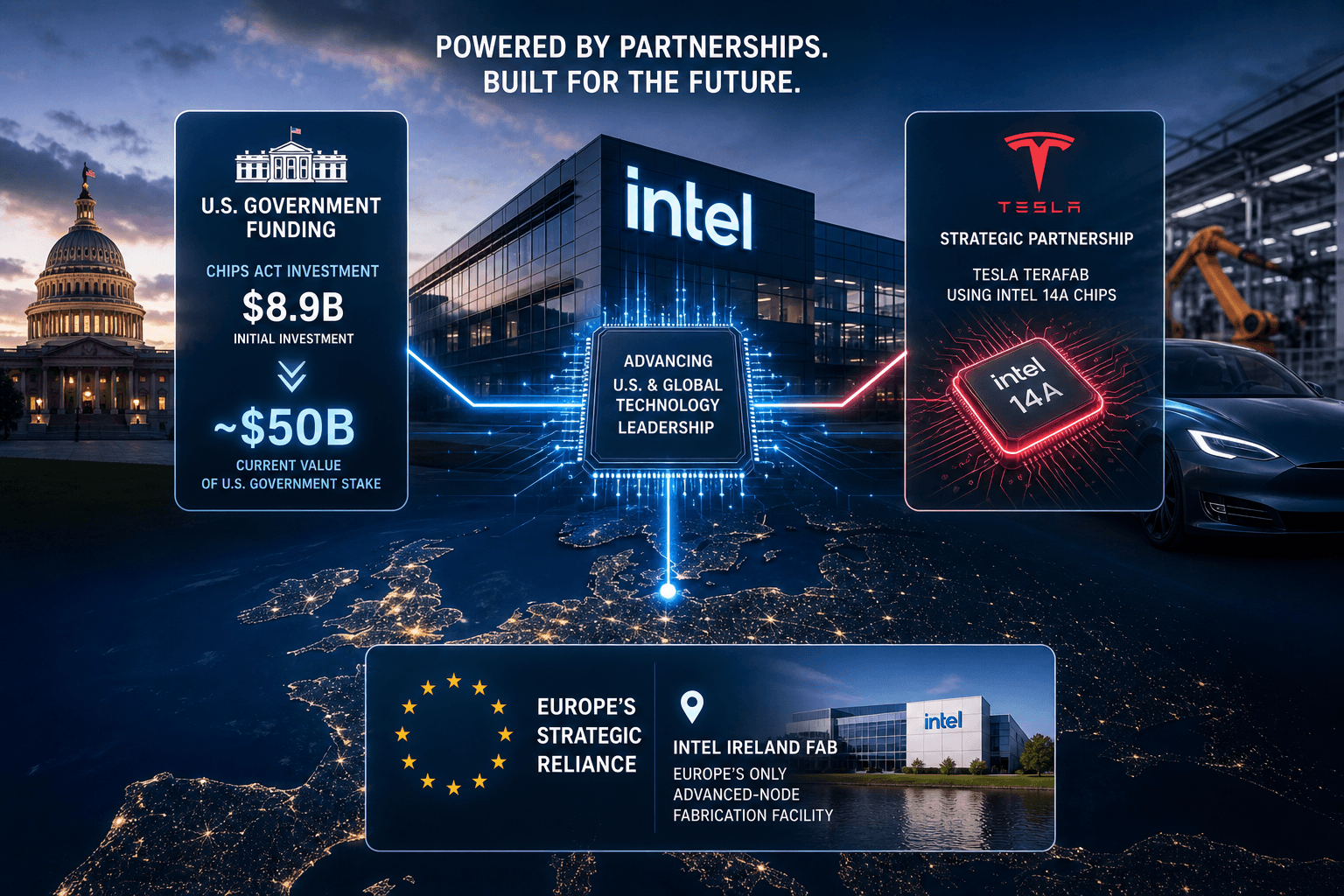
Tesla plans to use Intel’s upcoming 14A process node for its Terafab AI infrastructure. This is more than a supply agreement—it’s a high-stakes validation of Intel’s manufacturing roadmap.
When a company like Tesla commits to a future node, it sends a strong signal across the ecosystem: Intel is once again a viable contender in cutting-edge chip production.
Government Backing Has Transformed Intel’s Position
The role of the U.S. government in Intel’s resurgence cannot be overstated.
A roughly $8.9 billion investment aimed at strengthening domestic semiconductor capacity is now estimated to be worth around $50 billion. This reflects not just Intel’s financial recovery, but the increasing value of owning advanced chip manufacturing capabilities.
This momentum is also visible in market performance, where Intel has experienced a sharp rally in investor confidence, as seen in Intel’s historic stock surge in April 2026.
The implication is clear: Intel is no longer just a company—it is becoming a strategic asset.
Europe’s Dependence Highlights a Bigger Shift
Intel’s fabrication facility in Ireland has taken on outsized importance. It currently represents Europe’s only advanced-node semiconductor production site, making it critical to the region’s technological independence.
This reliance underscores a broader transformation: chip manufacturing is no longer just about efficiency—it’s about sovereignty.
Key Developments & Industry Reactions
Intel’s resurgence is reshaping the semiconductor landscape in several ways:
- Governments are becoming active stakeholders, not passive regulators
- Hyperscalers like Tesla are influencing winners, not just buying chips
- Market competition is now tied to national strategy, not just innovation
This raises deeper questions about fairness and market dynamics. When state backing and corporate demand align, traditional competition models begin to shift.
Why This Matters
The implications extend far beyond Intel itself:
- AI chips are becoming sovereign assets tied to national power
- Semiconductor firms are evolving into infrastructure providers
- “Too strategic to fail” is no longer theoretical—it’s operational reality
Control over advanced chip manufacturing now directly impacts economic resilience, military capability, and technological leadership.
Broader Context: A Global Semiconductor Realignment
Intel’s turnaround is part of a much larger global trend.
Governments and corporations are racing to localize semiconductor production, reduce dependency, and secure supply chains. This shift is visible worldwide, with major investments reshaping where and how chips are produced, as seen in Samsung’s massive $17B U.S. chip plant investment in Texas.
The era of globally optimized supply chains is giving way to regionally secured infrastructure.
Future Implications
If current trends continue:
- Semiconductor companies will operate like critical utilities
- AI capacity will become a measure of geopolitical strength
- Public-private partnerships will define technology leadership
Intel’s execution from here will be crucial—not just for its shareholders, but for the broader ecosystem now relying on its success.
Key Takeaways
- Intel has rebounded strongly, driven by AI demand and strategic deals
- Tesla’s adoption of Intel’s 14A chips validates its future roadmap
- U.S. government backing has amplified Intel’s strategic importance
- Europe depends heavily on Intel for advanced semiconductor production
- The semiconductor industry is shifting from business competition to geopolitical infrastructure
Conclusion
Intel’s story is no longer about catching up—it’s about redefining its role in a world where chips underpin everything from AI to national security.
As demand accelerates and governments step in, semiconductors are becoming sovereign assets. In that reality, Intel isn’t just back—it’s becoming indispensable.