Introduction
Artificial intelligence has advanced rapidly, but one major issue has consistently limited its reliability: AI hallucinations.
These errors—where AI generates incorrect or misleading information—have raised serious concerns across industries. From healthcare to finance, accuracy is not optional.
Now, a new breakthrough is changing that.
Self-correcting AI—AI that can verify its own outputs—is emerging as a powerful solution. This advancement is not just improving performance; it is redefining how AI systems operate.
Instead of simply generating answers, AI can now analyze, verify, and refine its own responses before presenting them.
What Is Self-Correcting AI?
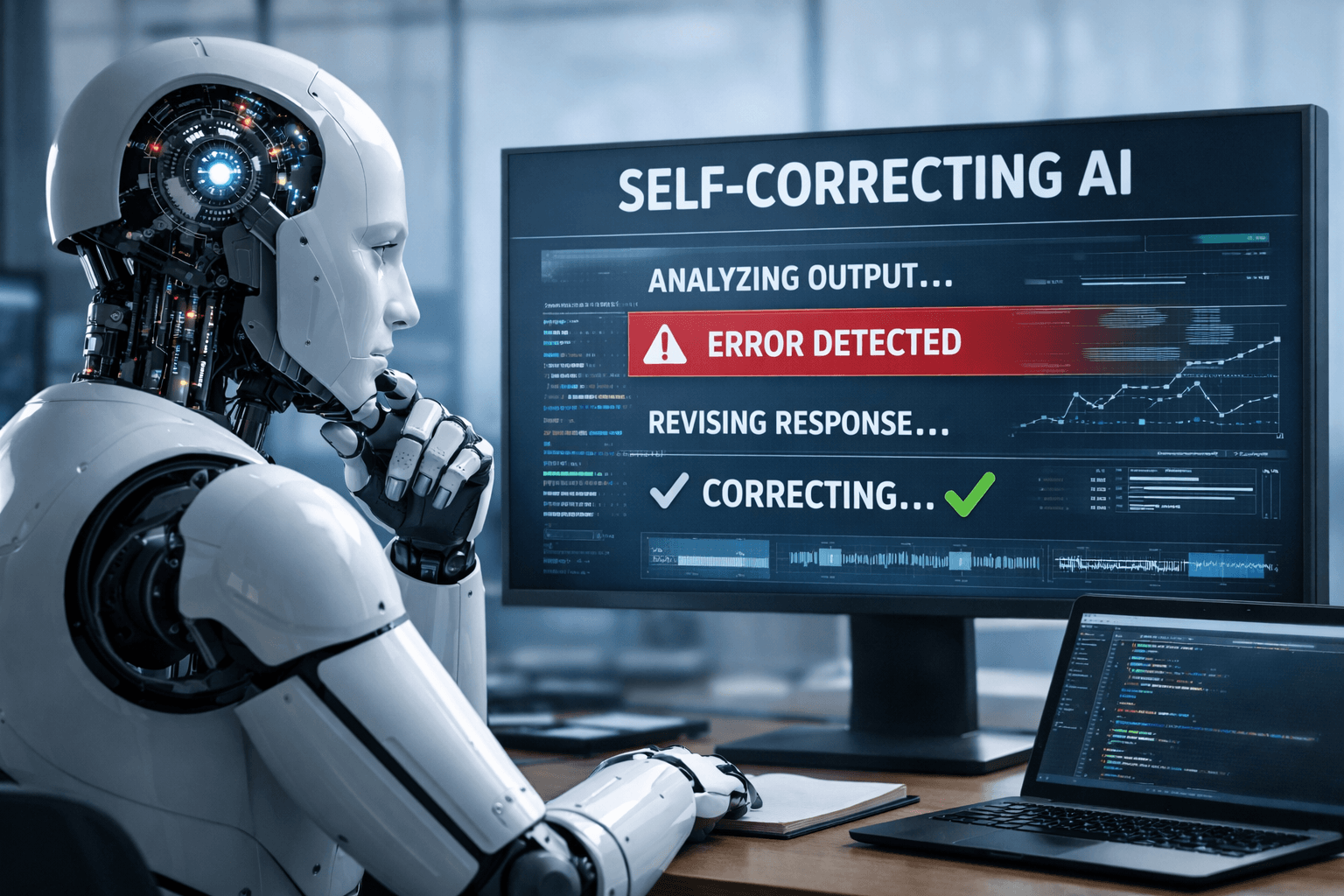
Self-correcting AI refers to artificial intelligence systems designed to verify and improve their own outputs before delivering results.
These systems can:
- Check responses for accuracy
- Detect logical inconsistencies
- Revise incorrect or weak answers
Unlike traditional AI models, which provide a single output, self-correcting AI uses iterative reasoning and validation loops.
In simple terms:
Self-correcting AI doesn’t just answer questions—it checks its answers before you see them.
How Self-Correcting AI Works
Recent advancements in AI architecture have made self-correcting AI possible. These systems rely on multiple layers of verification.
1. Multi-Step Reasoning
AI generates an initial response and then performs additional reasoning passes to:
- Re-evaluate logic
- Improve accuracy
- Refine clarity
2. Internal Verification Systems
Some models include built-in “critic” mechanisms that:
- Analyze outputs
- Identify errors
- Suggest improvements
3. External Tool Integration
Self-correcting AI can use tools such as:
- Search engines
- Databases
- Code execution systems
This allows AI to validate information instead of guessing.
Why Self-Correcting AI Matters
The rise of self-correcting AI directly addresses the biggest challenge in AI adoption: trust.
1. Improved Accuracy and Reliability
Industries like healthcare, finance, and law depend on precise information.
Self-correcting AI significantly reduces errors, making AI more dependable.
2. Reduced Human Oversight
Traditional AI requires constant human verification.
Self-correcting AI can self-audit, enabling faster and more efficient workflows.
3. Scalable Automation
By improving reliability, self-correcting AI enables:
- Large-scale automation
- Reduced operational costs
- Faster decision-making
4. Foundation for Autonomous AI
Self-correcting AI is essential for building:
- AI agents
- Autonomous systems
- End-to-end AI workflows
Without verification, autonomy is risky. With it, autonomy becomes viable.
Is This the End of AI Hallucinations?
Self-correcting AI does not completely eliminate hallucinations, but it dramatically reduces their frequency and impact.
Key improvements include:
- Higher factual accuracy
- Better logical consistency
- Increased user trust
This marks a major shift from:
“AI might be correct”
to
“AI can verify its correctness”
Future of Self-Correcting AI
The development of self-correcting AI is setting the stage for the next era of artificial intelligence.
1. Autonomous AI Agents
AI systems will be able to:
- Plan tasks
- Execute actions
- Verify results independently
2. AI in Scientific Research
Self-correcting AI can:
- Test hypotheses
- Validate findings
- Accelerate discoveries
3. AI-Driven Organizations
Businesses may increasingly rely on AI systems that:
- Make decisions
- Optimize operations
- Continuously improve performance
4. Higher Standards for AI Trust
As self-correcting AI becomes mainstream, users will expect:
- Verified outputs
- Transparent reasoning
- Minimal errors
Key Takeaways
- Self-correcting AI enables systems to verify their own outputs
- It directly addresses the issue of AI hallucinations
- Improves accuracy, trust, and reliability
- Reduces the need for human oversight
- Enables autonomous AI systems and workflows
Conclusion
Self-correcting AI represents a critical turning point in the evolution of artificial intelligence.
By enabling AI to validate its own outputs, this technology transforms AI from a tool that generates answers into a system that ensures those answers are reliable.
As adoption grows, self-correcting AI will play a central role in building trustworthy, autonomous, and scalable AI systems.
The future of AI is no longer just about generating information.
It is about verifying it with confidence.