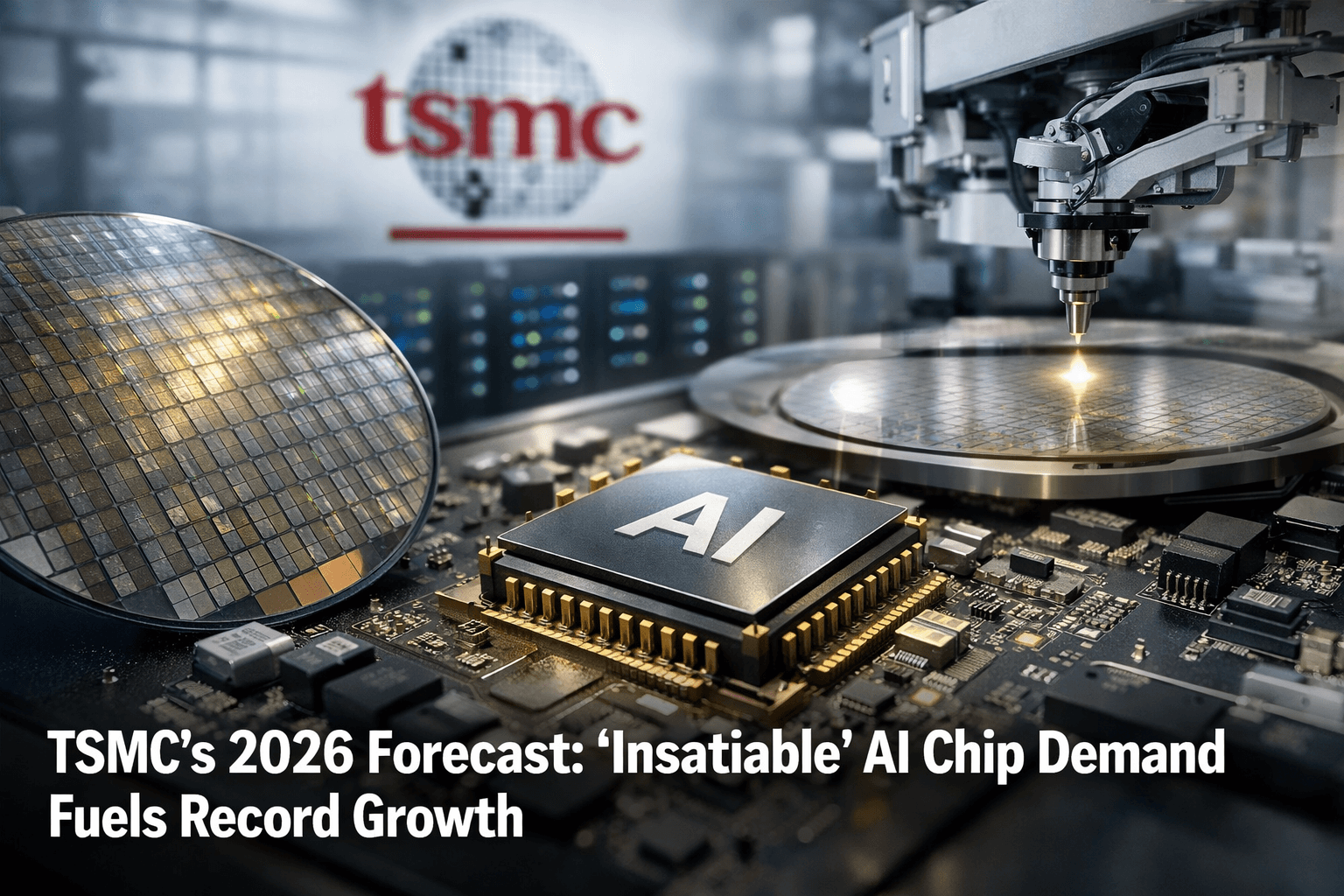
Summary: TSMC reported a 58% jump in Q1 2026 profit on a 35% revenue surge (to $35.9B), led by booming AI/HPC chip orders. CEO C.C. Wei said AI-related demand is “extremely robust” and raised the full-year revenue forecast to above 30% growth. To meet this “insatiable” demand, TSMC is stepping up CapEx to the high end of its $52–56B range and fast-tracking 3nm capacity worldwide (new fabs in Taiwan in 2027, Arizona 2H 2027, Japan 2028). Analysts (e.g. Nomura) now foresee ~30%+ growth, far above earlier ~20% estimates. This strong outlook underscores TSMC’s pivotal role in powering the AI surge and has lasting implications for chip supply, pricing, and global tech growth.
Record Q1 Performance and Upgraded 2026 Outlook
In Q1 2026 TSMC delivered NT$1.134 trillion (US$35.71B) in revenue – a 35% year-on-year jump – and net profit of NT$572.5B (US$18.2B), up 58% YoY. This beat analysts’ forecasts and aligned with TSMC’s guidance. The strength was driven entirely by the AI and HPC segment; traditional consumer chips like smartphones have waned in comparison. Following the results, TSMC raised its 2026 revenue guidance to “above 30%” growth in USD terms, up from a prior ~30% estimate. CFO Wendell Huang confirmed 2026 CapEx will be at the high end of the USD$52–56B range. In other words, TSMC is cranking up investment to meet demand – a rare signal of confidence in the cycle. Even against the backdrop of Middle East energy worries, analysts noted that analysts have lifted Q2 estimates by ~2.3% (to a record level) because they expect constrained chip supply to drive upside.
Insatiable AI Demand Drives Growth
TSMC’s management repeatedly emphasized that AI chip demand remains “extremely robust.” CEO C.C. Wei highlighted a shift from “generative AI” to more advanced “agentic AI,” driving ever higher compute needs. Cloud giants and hyperscalers are “providing very strong signals and positive outlook,” Wei said, reinforcing their multi-year confidence in AI-driven growth. In effect, the world’s biggest GPU and AI chip orders are locked in – Nvidia and others have essentially pre-committed capacity.
This is reflected in TSMC’s revenue mix. High-performance computing (HPC) and AI chips now account for roughly 61% of TSMC’s revenue (up from ~40% two years ago). By contrast, smartphone chips comprise only ~26%. Advanced nodes dominate this shift: in Q1 2026, TSMC’s 3nm node was ~25% of sales and 5nm ~36%, meaning 3nm+5nm made up ~61% of sales. As one analyst noted, TSMC’s fabs are “running hot and the AI story just keeps delivering”. In short, cloud/AI workloads now drive the company, dwarfing the legacy consumer segment.
Capacity Crunch Spurs Massive Expansion
TSMC admits it’s hitting the limits of current capacity. Demand for leading-edge chips far outstrips supply: 2nm and 3nm capacity are “fully sold out into 2027 and beyond,” according to analysts. Management repeatedly noted the urgency: they are “stepping up our CapEx… to increase our N3 capacity”. Practically, this means fast-tracking new fabs and retooling existing ones. TSMC is adding a new 3nm fab in Taiwan (Tainan) slated for mass production in H1 2027, and its Arizona Fab 2 will also run 3nm starting 2H 2027. Even Japan’s second fab is being converted to 3nm for a 2028 ramp. Simultaneously, TSMC is redeploying 5nm lines into 3nm to squeeze out more output.
The scale of investment is historic. TrendForce notes research houses (Morgan Stanley, Goldman, JPMorgan, Nomura, etc.) expect ~US$150B total CapEx over three years. Fubon and Morgan Stanley foresee 2026 spending of $50–$52B (up from $40B in 2025). CFO Huang added that even after this year’s $56B, the next few years’ CapEx will be “significantly higher” than prior years. In short, TSMC is betting everything on building enough capacity for the AI era – a bold strategy justified by locked-in orders but raising questions about timing (new fabs take 2–3 years to turn on).
Analyst Forecasts vs. Company Guidance
Market expectations are rapidly adjusting. Before the Q1 results, many analysts had been more cautious about 2026 growth (one note cited consensus ~20% growth). Now TSMC’s guidance of “above 30%” is backed by some sell-side forecasts: for example, Nomura projects +31.4% revenue in 2026. By comparison, Bernstein (via Motley Fool) notes 2026 was previously pegged around +20%.
These revisions mirror the share-price reaction: TSMC hit record highs in April 2026, trading well above its peers. Gross margin also expanded (66.2% in Q1), reflecting pricing power on hot AI nodes. Investors now see TSMC as “locked in” to hyperscaler spending, with a multi-year visible order book that is rare for semis. One commentator on Seeking Alpha concluded that TSMC is the critical bottleneck in the AI supply chain, given its sold-out advanced node pipeline.
Why It Matters: Real-World Impact and Long-Term Outlook
TSMC’s outlook has broad implications. First, it signals that the AI infrastructure buildout shows no signs of abating. Every “token” processed in generative AI demands more silicon, meaning continued investment in data centers, edge AI, and AI PCs. Second, the chip industry supply is now heavily concentrated: if TSMC can’t meet demand, customers (e.g. Nvidia, Google, AWS, Apple) risk bottlenecks or must pay up. In fact, TSMC announced four straight years of price hikes (5–20%) on 3nm/5nm wafers, as margins stay above 60%. These higher prices will cascade into the cost of everything from smartphones to AI hardware.
Geopolitically, TSMC’s ramp-up underscores why chip security is a national issue. Governments (Taiwan, US, Japan) are partnering on fabs precisely because leading-edge AI chips are now critical infrastructure. TSMC’s projects in the U.S. and Japan will help diversify supply, but also lock in huge capital in those regions. Meanwhile, Elon Musk’s TeraFab plan was dismissed by Wei: there are “no shortcuts” in foundry work – fabs take years to build and qualify. This reinforces that advanced chip manufacturing remains highly specialized.
Finally, the long-term picture: TSMC’s leadership means it is setting industry trends. As 2nm/3nm come fully online, newer nodes (N2 in 2027) and advanced packaging (CoWoS) will continue to drive growth. Analysts like Goldman expect AI accelerators will form >40% of TSMC’s revenue by 2029 (up from ~15% today). In short, TSMC is betting on a future where virtually every tech product has a powerful AI chip inside. For readers, this means the semiconductor shortage seen in 2024–2025 may persist for AI-specific chips at least into 2027, even as older chips ease up. It also means that technologies like cloud AI, self-driving cars, and IoT will continue to accelerate, powered by the silicon TSMC and its partners produce.
Key Takeaways
Q1 2026 Upsurge: TSMC’s Q1 revenue soared 35% YoY to $35.9B (NT$1.134T), with net profit +58%. Advanced AI chips (3nm/5nm) now dominate sales.
Raised Outlook: The company now forecasts >30% revenue growth in 2026, raising full-year guidance on robust AI demand signals.
Capacity Bottleneck: TSMC’s fabs are at full tilt. In response it’s ramping 3nm capacity worldwide (new fabs in Taiwan 2027, US 2027, Japan 2028) and converting 5nm lines to 3nm.
Massive CapEx: 2026 spending will be at the high end of $52–56B, with analysts (Morgan Stanley, JPMorgan, etc.) projecting $50–56B for 2026 and even higher in 2027.
Analyst Estimates: Sell-side forecasts have jumped: Nomura sees ~+31% growth in 2026 vs. prior consensus ~+20%, reflecting the “locked in” AI orders.
Industry Impact: These developments confirm that AI infrastructure demand is real and long-term. TSMC’s lead means continued tight supply for advanced chips, sustained high margins, and accelerating investment in the global semiconductor ecosystem.
Conclusion
TSMC’s latest results and outlook make clear that the AI chip boom is far from a fad – it’s a structural, multi-year trend. By doubling down on capacity (investing record sums in 3nm fabs and beyond) while guiding 30%+ growth, TSMC is effectively betting the farm on AI/HPC applications. For technology and innovation platforms, this means three things: (1) AI-driven hardware growth will underpin future tech developments, (2) semiconductor supply will remain a strategic issue (with TSMC at the center), and (3) companies reliant on chip supply (cloud providers, automakers, consumer device makers) must plan for tight, high-cost markets for at least the next few years. Ultimately, TSMC’s “insatiable” AI chip demand narrative shows how deeply chipmaking is intertwined with the broader tech revolution, underscoring why this forecast is both a short-term headline and a long-term signal for the industry.