When Technology Becomes Power
For decades, the United States has tried to limit the spread of uranium enrichment technology.
Not because nuclear energy is controversial.
But because enrichment sits at the intersection of civilian development and military capability.
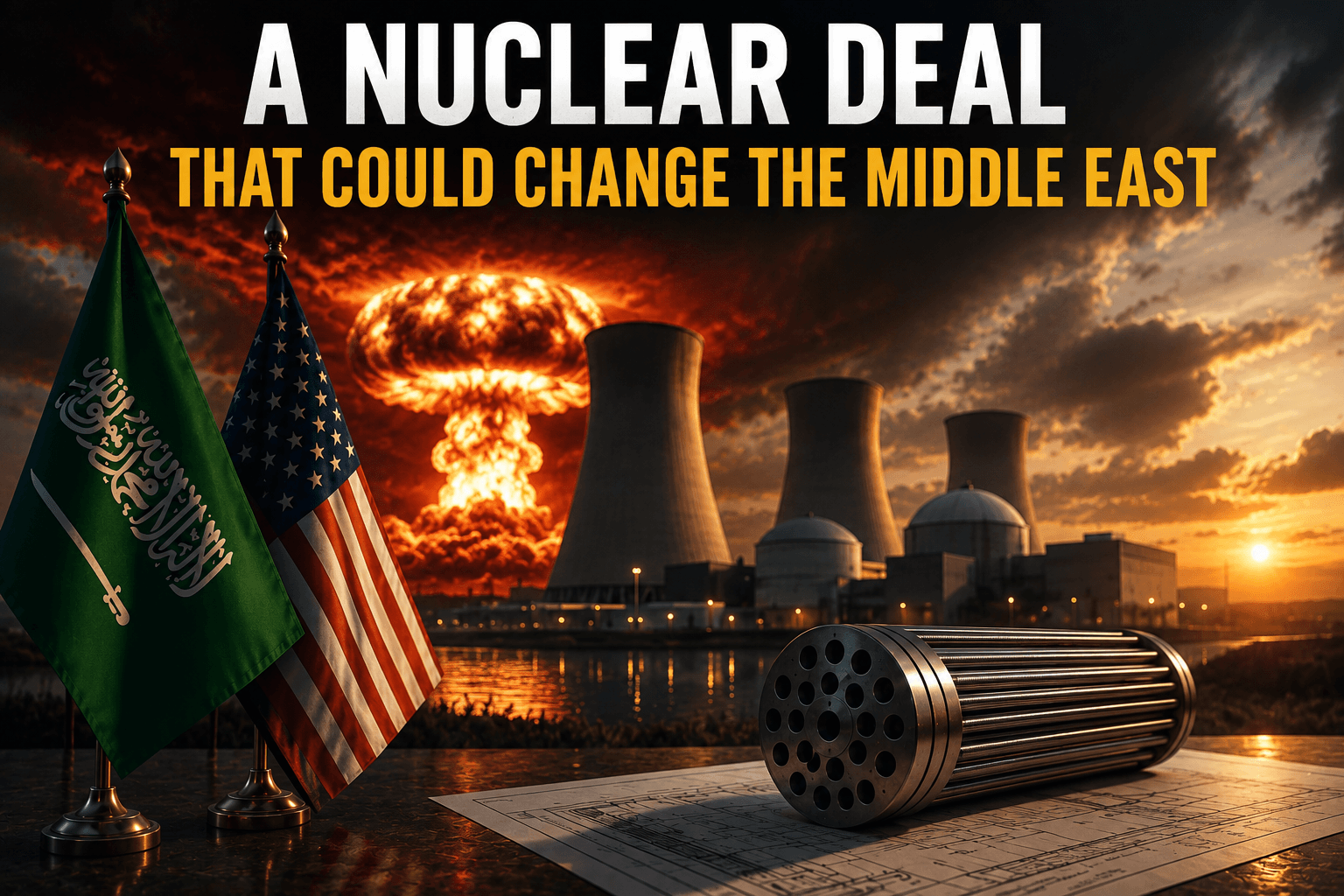
Now Washington appears ready to support a civilian nuclear program for Saudi Arabia that could eventually include uranium enrichment inside the kingdom itself.
If implemented, it would represent one of the most consequential shifts in U.S. nuclear policy in years.
The agreement isn’t simply about building reactors.
It is about redefining who can possess one of the world’s most strategically sensitive technologies.
The Technology That Changes Everything
Most countries that operate nuclear power plants never enrich their own uranium.
Instead, they buy fuel from a small group of international suppliers.
That arrangement was intentional.
Following the Cold War, much of the global non-proliferation system was designed around separating access to nuclear energy from access to the technologies needed to produce nuclear fuel.
Enrichment became one of those technologies.
Because the same centrifuges that produce low-enriched uranium for power plants can, if further expanded or reconfigured, produce highly enriched uranium suitable for nuclear weapons.
The difference is often a matter of degree rather than kind.
That is why enrichment has always occupied a unique place in international politics.
Owning the capability changes what a country could do—even if it never chooses to do it.
A Different Kind of Security Guarantee
For decades, Saudi Arabia relied primarily on American security guarantees rather than independent strategic capabilities.
That regional order is becoming less certain.
The Middle East today looks very different from the one that emerged after the Gulf War.
Iran has steadily expanded its nuclear capabilities.
China has become a major diplomatic and economic player in the Gulf.
Russia remains an influential security actor across the region.
Meanwhile, U.S. foreign policy has increasingly shifted attention toward competition in the Indo-Pacific.
Saudi Arabia has responded by pursuing greater strategic autonomy.
It has diversified its defense partnerships.
Expanded relations with China.
Balanced ties with Russia.
Invested heavily in advanced industries.
A domestic nuclear fuel cycle fits naturally into that broader strategy.
Countries that want greater strategic independence increasingly seek control over critical technologies—not simply access to imported products.
The Return of Strategic Technology
The agreement also reflects a broader change occurring far beyond the Middle East.
Technology is increasingly being treated as an instrument of national power.
Advanced semiconductors.
Artificial intelligence.
Quantum computing.
Rare earth processing.
Space launch capabilities.
Biotechnology.
And now, once again, nuclear technology.
Governments are becoming less willing to treat these capabilities as ordinary commercial goods.
Instead, they are increasingly viewed as strategic assets that shape national resilience, economic competitiveness and geopolitical influence.
The debate is no longer simply about who can buy technology.
It is increasingly about who is allowed to build it.
A New Question for Non-Proliferation
For decades, the global non-proliferation system relied on a relatively simple bargain.
Countries could develop civilian nuclear energy.
But only a limited number would possess the full nuclear fuel cycle.
That distinction is becoming harder to maintain.
If Saudi Arabia is permitted to enrich uranium under American approval, other countries may reasonably ask why similar arrangements should not apply to them.
Every exception changes expectations.
Every new precedent becomes part of future negotiations.
The challenge for policymakers is no longer preventing the spread of nuclear technology altogether.
That era has largely passed.
The challenge is managing a world in which more countries possess increasingly sophisticated strategic capabilities while preserving regional stability.
The Bigger Shift
This agreement will inevitably be debated in terms of Saudi Arabia, Iran and the politics of the Middle East.
Those debates matter.
But they may not prove to be its lasting significance.
The deeper shift is that the international system is entering an era where strategic technologies are becoming central to national sovereignty.
Countries no longer measure power only by military strength or economic size.
They increasingly measure it by the technologies they control.
Artificial intelligence.
Semiconductors.
Space launch systems.
Advanced manufacturing.
Nuclear fuel cycles.
The list continues to grow.
The proposed U.S.–Saudi agreement is therefore more than a nuclear deal.
It reflects a world in which technological capability is becoming one of the defining currencies of geopolitical power.
And once countries begin competing over capabilities rather than products, the rules of international politics begin to change.