A Partnership That Strengthens Samsung’s AI Push
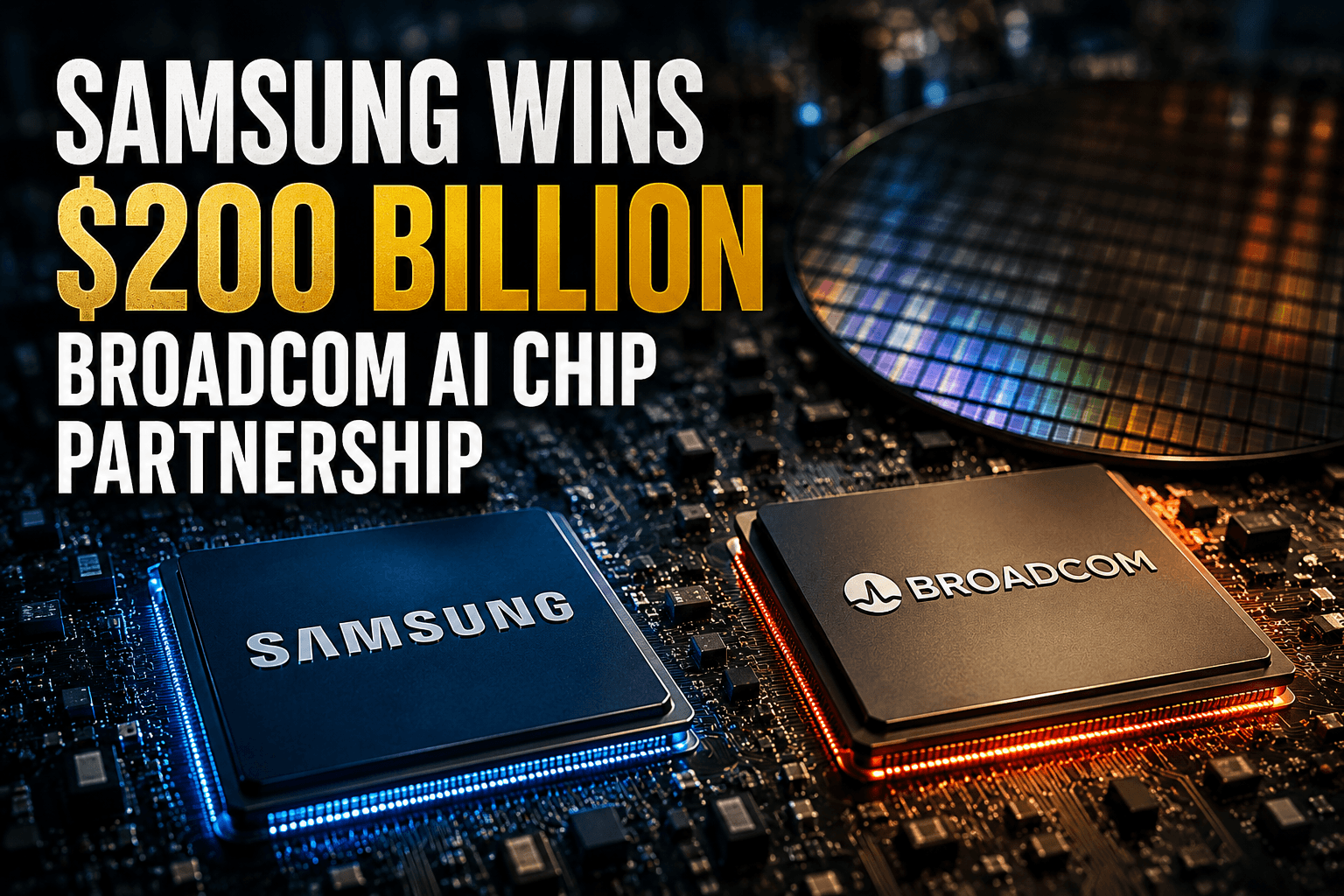
Samsung Electronics has secured a long-term semiconductor partnership with Broadcom reportedly worth around $200 billion through 2030, making it one of the largest commercial agreements in the company’s foundry business.
The partnership is expected to cover the manufacturing of Broadcom’s next-generation AI communication chips, along with advanced packaging and memory technologies. As demand for AI infrastructure continues to grow, the agreement gives Broadcom additional manufacturing capacity while providing Samsung with one of its most significant foundry wins in recent years.
For a company that has spent years investing heavily to expand its contract chip manufacturing business, the deal represents far more than another customer announcement.
Why Broadcom Matters
Broadcom has quietly become one of the most important companies in the AI ecosystem.
While Nvidia’s graphics processors power much of today’s artificial intelligence, Broadcom develops custom AI chips and networking hardware used by some of the world’s largest cloud providers. Those components help move enormous volumes of data between processors, making them an essential part of modern AI infrastructure.
As AI adoption accelerates, companies like Broadcom need manufacturing partners capable of producing advanced chips at both high quality and high volume.
That is where Samsung enters the picture.
A Significant Step for Samsung
Samsung is already a global leader in memory chips, but its ambitions extend well beyond memory.
For years, the company has been investing billions of dollars to grow its foundry business, where it manufactures chips designed by other companies. Competing in this market has been difficult because TSMC has built deep relationships with many of the world’s leading semiconductor firms.
Winning Broadcom does not immediately change that balance.
But it does provide Samsung with something equally valuable—a major customer willing to trust its most advanced manufacturing capabilities for AI-related products.
That confidence could help Samsung compete for similar projects in the future.
What This Means for the AI Industry
The agreement also reflects how rapidly the AI industry is evolving.
Only a few years ago, much of the conversation centered on who could design the most powerful AI chips.
Today, another challenge has become equally important: producing enough of those chips to meet demand.
As AI models become larger and cloud companies continue expanding their infrastructure, reliable manufacturing, advanced packaging, and memory are becoming increasingly important parts of the industry.
This is one reason partnerships like the one between Samsung and Broadcom are attracting so much attention.
Whether this agreement becomes a turning point for Samsung will depend on how successfully the company executes over the coming years. Large contracts create opportunities, but they also raise expectations.
What this partnership already makes clear, however, is that the AI economy is being built not only by the companies designing breakthrough technologies, but also by those capable of manufacturing them at scale.