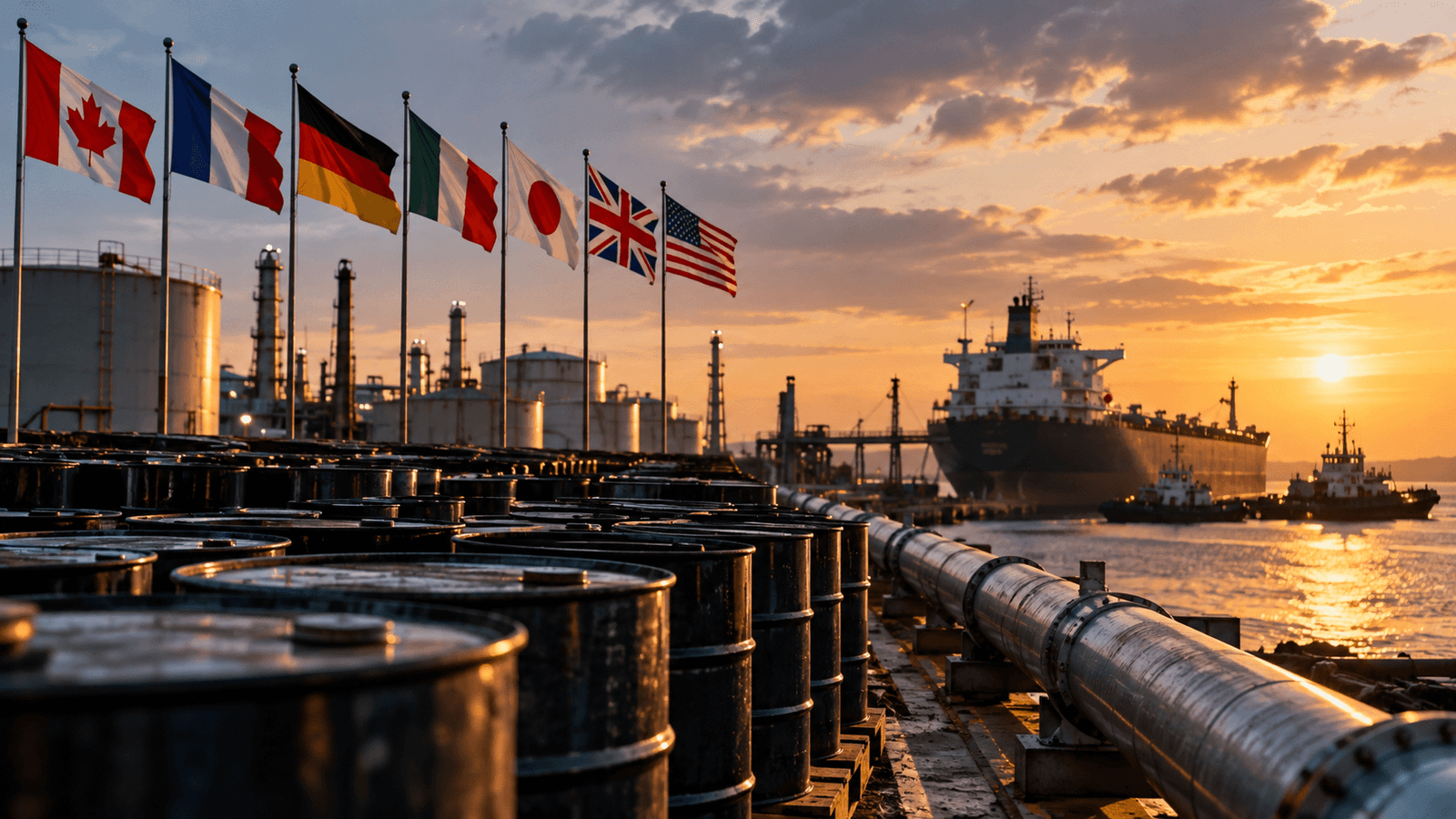
S&P Global has maintained a relatively resilient outlook for the global economy in its September 2026 Economic Outlook, while warning that rising energy prices, persistent inflation and higher interest rates are increasing risks to growth.
The latest outlook, published on September 16, comes as global economic activity continues to show signs of resilience. S&P Global said its purchasing managers’ indices indicate global growth running at around a 3% annualised rate, supported in part by investment linked to artificial intelligence and relatively firm demand in several major economies.
However, renewed increases in oil and European natural gas prices have complicated the inflation outlook and could put further pressure on central banks and financial markets.
Energy prices create fresh inflation risks
A major concern in S&P Global’s September outlook is the renewed rise in energy prices.
Brent crude has moved back above $100 a barrel, while European natural gas prices have risen significantly since late July. S&P Global said the increase has been larger than assumed in its previous forecasts.
Higher energy costs can affect the wider economy by increasing transportation, production and household expenses. If elevated energy prices persist, businesses may pass higher costs on to consumers, making it more difficult for inflation to return to central banks’ targets.
S&P Global currently expects Dated Brent to be around $89 a barrel at the end of 2026 and $86 a barrel at the end of 2027, although it highlighted considerable uncertainty around the outlook.
Global growth remains resilient
Despite the renewed energy shock, the global economy has not shown signs of a broad-based collapse.
S&P Global said its global PMI indicators point to continued expansion, with the composite output index recording a fifth consecutive monthly improvement in August. Stronger-than-expected economic data from several countries have also resulted in upward revisions to some growth forecasts.
Investment in artificial intelligence has emerged as an important source of economic activity, particularly in technology-related sectors and parts of Asia.
The outlook nevertheless remains vulnerable to a prolonged deterioration in energy supplies and financial conditions.
Higher interest rates add to economic pressure
The combination of stronger energy prices and persistent inflation is creating a difficult environment for central banks.
S&P Global expects further monetary-policy tightening in some major economies, although the outlook differs between central banks. Its September assessment describes the Federal Reserve’s expected path as potentially involving one further move, while policy normalisation is expected to continue in Japan.
Higher policy rates are being accompanied by elevated long-term government bond yields.
The 10-year US Treasury yield is around 5%, according to S&P Global, while long-term borrowing costs have also risen in several European markets.
Higher yields can increase borrowing costs for governments, businesses and households and can therefore weigh on investment and consumption.
India growth forecast raised to 6.5%
India remains one of the stronger-growing major economies in S&P Global’s latest outlook.
The agency raised its forecast for India’s 2026 economic growth to 6.5%, an increase of 0.3 percentage points from its previous projection. The revision followed stronger-than-expected economic data at the start of India’s current fiscal year.
However, India is not insulated from the global energy and inflation risks identified in the report. S&P Global’s latest PMI data also indicate renewed price pressures in the Indian economy.
The combination of comparatively strong domestic growth and higher energy costs will therefore remain an important factor for India’s economic outlook.
China faces weaker domestic demand
China’s economic outlook remains more restrained. S&P Global expects China’s real GDP growth at 4.3% in both 2026 and 2027.
The agency points to weak domestic demand, continued challenges in the property sector and subdued confidence as constraints on the economy. Strong exports are providing support, but they have not fully offset domestic weaknesses.
The outlook also suggests that the performance of China’s domestic economy will remain an important factor for the wider Asia-Pacific region.
What could affect the global outlook?
The immediate outlook depends heavily on how long elevated energy prices persist and whether higher costs begin to generate broader inflationary pressures.
A prolonged disruption in energy supplies could force central banks to maintain tighter monetary policies for longer. That would increase borrowing costs and potentially weaken economic activity and financial markets.
At the same time, continued investment in artificial intelligence, resilient consumer demand and stronger-than-expected economic activity provide important support to global growth.
S&P Global therefore sees a global economy that remains resilient but faces a more complicated risk environment than earlier in the year.