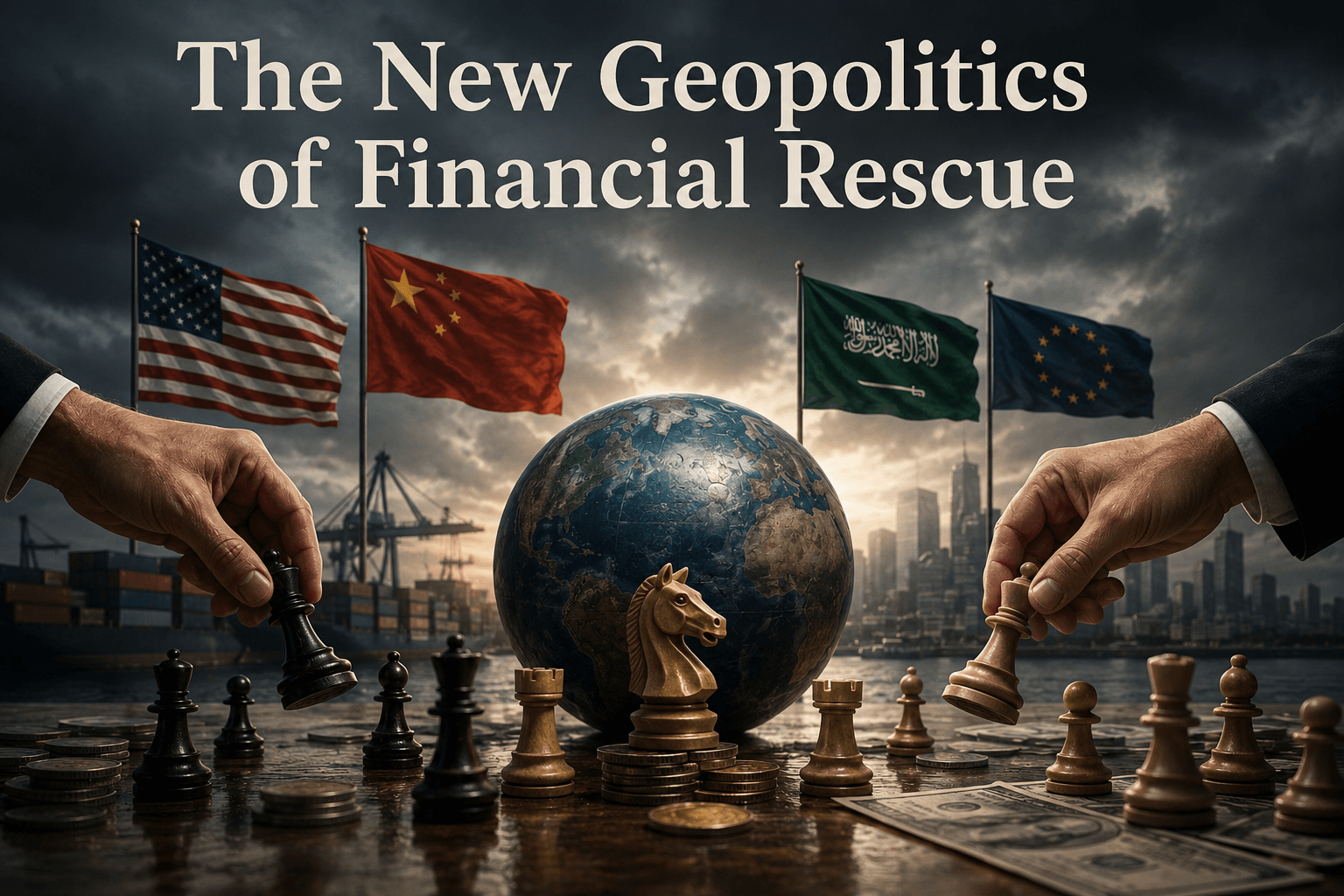
The New Geopolitics of Financial Rescue
Pakistan has reportedly approached the United States seeking financial assistance worth around $10 billion, as the country continues to face pressure from high external debt, weak foreign exchange reserves and the need to stabilise its economy.
On the surface, this looks like another story about a country in financial distress.
It isn’t.
The more important story is that economic crises are increasingly becoming moments of geopolitical competition.
Not because debt itself is new.
But because the world has changed around it.
Economic Crises Have Always Crossed Borders
No country facing a severe balance-of-payments crisis solves it entirely alone.
When foreign exchange reserves fall and external financing becomes scarce, governments look outward.
They negotiate with international financial institutions.
They seek support from partner countries.
They attract foreign investment.
The immediate objective is simple: restore stability before the crisis deepens.
That has always been true.
What is changing is the strategic importance of those providing the support.
Why the Choice of Lender Matters
A financial rescue is rarely just a transfer of money.
It begins a relationship.
Loans create long-term engagement.
Investment creates commercial interests.
Development projects generate years of cooperation between governments, businesses and institutions.
Over time, these relationships can influence how countries cooperate on trade, infrastructure, technology and regional security.
That does not mean financial assistance automatically determines foreign policy.
Countries retain their own interests and priorities.
But periods of economic vulnerability often make international relationships more consequential than they would be under normal circumstances.
The weaker a country’s financial position, the fewer options it has to ignore the interests of those willing to help.
Pakistan Reflects a Larger Shift
Pakistan occupies one of the world’s most strategically important regions, linking South Asia, Central Asia and the Middle East.
Its economic relationships already span multiple centres of power.
China has invested heavily through the China–Pakistan Economic Corridor.
The Gulf states have periodically provided financial support.
International financial institutions have remained important during previous economic crises.
Now, reports of a request for substantial U.S. assistance add another dimension to that landscape.
Viewed individually, none of these relationships is unusual.
Viewed together, they illustrate how economic resilience and geopolitical strategy are becoming increasingly intertwined.
The Competition Is No Longer Just Among Borrowers
Much of the discussion around sovereign debt focuses on the countries seeking assistance.
But the more significant change may be happening among those providing it.
Today, major powers compete not only through military alliances or trade agreements, but also through development finance, infrastructure investment, export credit and long-term capital.
The objective is not simply economic return.
It is enduring presence.
Countries that finance ports often become partners in trade.
Countries that finance energy projects often gain long-term commercial influence.
Countries that help stabilise economies build relationships that can last well beyond the crisis itself.
Financial assistance has become one of the ways states build strategic partnerships without deploying military power.
A More Competitive Financial World Changes the Incentives
This is where the story becomes more interesting.
For much of the post-Cold War period, many countries depended on a relatively concentrated international financial system.
Today, governments facing economic pressure often have more potential sources of support.
Multilateral institutions.
The United States and its partners.
China.
Regional development banks.
Gulf sovereign wealth funds.
Greater choice does not automatically create greater freedom.
Multiple lenders can also bring competing expectations, overlapping obligations and new forms of dependence.
But competition among lenders does create something valuable.
Negotiating space.
Countries are increasingly able to diversify their economic relationships instead of relying exclusively on a single source of external finance.
In a more competitive financial system, influence is no longer determined only by who provides capital.
It is also shaped by whether borrowers have credible alternatives.
The Question Worth Watching
Whether Pakistan ultimately secures the requested assistance will matter for its economy.
But the larger significance lies beyond one negotiation.
If major powers increasingly compete to finance infrastructure, stabilise economies and expand long-term partnerships, financial crises may become moments when geopolitical influence is quietly renegotiated.
The future contest may not be over who receives financial assistance.
It may be over who becomes the indispensable financial partner when assistance is needed.
That is a different kind of competition.
One fought less with armies than with access, trust and capital.
And it may shape international relationships long after today’s economic crises have passed.