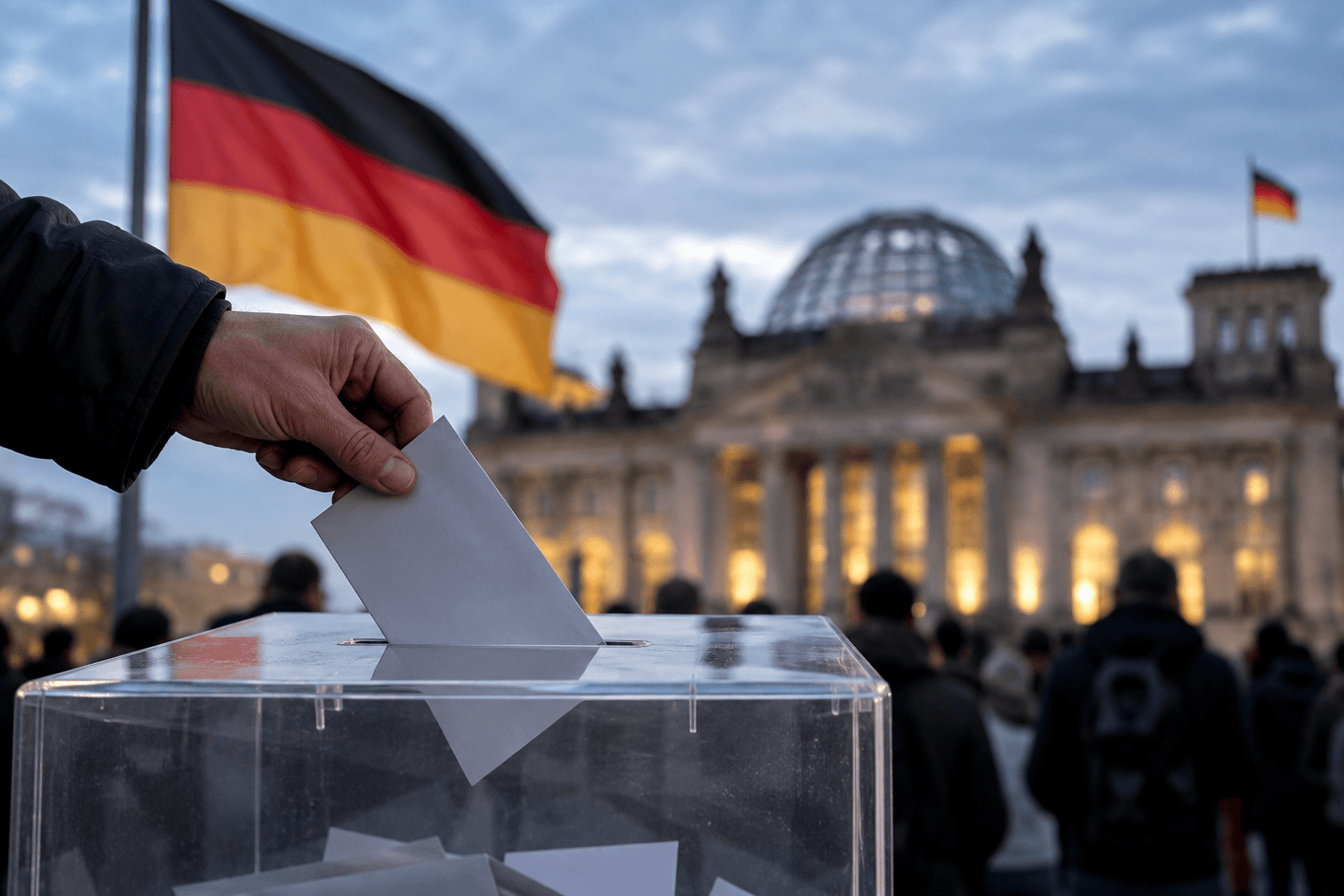
Germany’s far-right Alternative for Germany (AfD) has emerged as the strongest party in the Mecklenburg-Western Pomerania state election, while Chancellor Friedrich Merz’s Christian Democratic Union (CDU) suffered its worst result in the state’s post-war electoral history.
The AfD won around 38% of the vote, narrowly ahead of the centre-left Social Democratic Party (SPD), which received about 35.5%. The CDU, meanwhile, secured only around 5.2%, according to preliminary results.
The result comes just two weeks after the AfD recorded a major victory in another eastern German state, Saxony-Anhalt.
AfD’s second major state election victory
In the September 6 election in Saxony-Anhalt, the AfD won 43.8% of the vote, gaining 23 percentage points compared with the 2021 election. It secured 39 of the state’s 83 parliamentary seats, while the CDU fell to 17.2%.
That victory marked the AfD’s strongest result in the state’s history and increased political pressure on Merz and the federal CDU.
The party’s subsequent performance in Mecklenburg-Western Pomerania gives the AfD another first-place finish in eastern Germany within a matter of weeks. However, winning the largest share of votes does not automatically give the party the ability to form a state government, as other established parties have continued to rule out cooperation with the AfD.
Two German states went to the polls
The September 20 elections were held simultaneously in Mecklenburg-Western Pomerania and Berlin, producing sharply different results.
In Mecklenburg-Western Pomerania, the AfD finished first with about 37.7–38% of the vote, followed by the SPD with around 35.5%. The CDU’s result was close to the 5% threshold for parliamentary representation and represented a historic setback for the party.
Berlin produced a different political picture. The Left Party (Die Linke) emerged as the largest party with about 25% of the vote. The CDU finished second with roughly 20%, followed by the Greens at about 15% and the AfD at around 16%. The SPD fell to approximately 12%.
The results mean that the governing coalitions in both states face changes following the elections.
CDU faces growing pressure
For the CDU, the Mecklenburg-Western Pomerania result is particularly significant. The party’s roughly 5.2% share was described by German media as its worst result in a state election since the post-war formation of the Federal Republic. At one stage, projections had placed the CDU below the 5% threshold required for parliamentary representation.
Merz acknowledged the severity of the result, calling the outcome in Mecklenburg-Western Pomerania a “disaster.” He nevertheless said he intended to remain chancellor and continue with his government’s reform program.
The latest defeats add to pressure on the chancellor following the CDU’s poor performance in Saxony-Anhalt earlier this month.
What the results mean for the AfD
The consecutive results in Saxony-Anhalt and Mecklenburg-Western Pomerania underline the AfD’s growing electoral strength in parts of eastern Germany.
The party has also increased its support in Berlin, where it received around 16% of the vote, although it remained well behind the Left Party and CDU.
Despite its strong electoral performance, the AfD is expected to face difficulties in translating first-place finishes into state governments because other major parties have maintained their refusal to form coalitions with it.
The contrasting results in Berlin and Mecklenburg-Western Pomerania also show that the political shift is not uniform across Germany. While the AfD has made major gains in eastern states, Berlin’s election was led by the Left Party, with the CDU remaining the second-largest party.
For Germany’s federal government, however, the latest elections represent another important test of public support for Merz’s CDU-SPD coalition and its political and economic agenda.