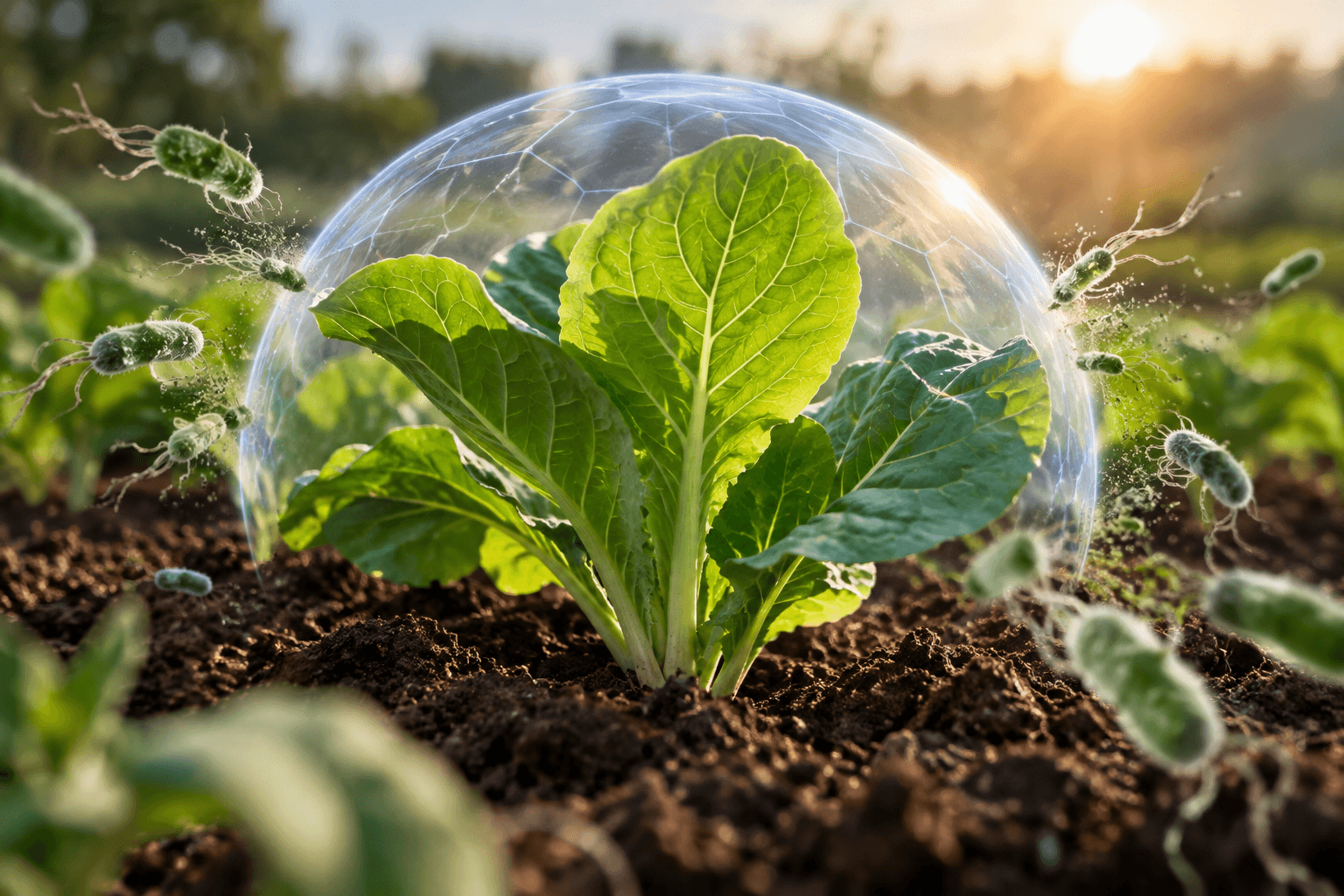
Scientists have developed a new approach to strengthening plants’ natural immune responses, potentially opening a path toward crops that can better defend themselves against bacterial diseases.
Researchers at Nanyang Technological University (NTU) in Singapore have investigated how the organisation of immune receptors on plant cells affects the strength and duration of a plant’s defence response. Their findings suggest that carefully controlling these molecular “sensors” could make plant immunity more effective without negatively affecting normal growth.
The study focuses on FLS2, a plant immune receptor that helps detect flagellin, a protein associated with many bacteria. When FLS2 recognises a bacterial threat, it activates a series of defence responses inside the plant.
How the plant immune system works
Unlike animals, plants do not have antibodies or mobile immune cells. Instead, individual plant cells rely on specialised receptors to recognise molecules associated with pathogens.
FLS2 is one of these receptors. When it detects bacterial flagellin, it works together with other proteins to trigger immune signalling. This can lead to a range of defensive responses that make it harder for pathogens to establish an infection.
The NTU researchers found that the number and organisation of these receptors can influence how effectively the immune response is maintained.
Rather than simply increasing the number of immune receptors, the researchers identified a specific receptor arrangement involving FLS2 and its partner receptors that produced a stronger and more sustained defence response.
Stronger defence without affecting plant growth
The researchers tested their approach in Arabidopsis thaliana, a small plant widely used in biological research.
According to the study, plants with the engineered immune-receptor configuration showed approximately 53% less bacterial growth compared with control plants.
The researchers also reported that enhancing the immune response did not come at the cost of normal plant growth in their experiments.
This is an important consideration in plant immunity research. A constantly activated defence system can require significant energy and resources, potentially reducing growth or productivity. Finding ways to strengthen pathogen resistance while avoiding this trade-off is therefore a major research goal.
What could this mean for agriculture?
The research could eventually contribute to the development of crops with stronger natural resistance to bacterial diseases.
If similar receptor configurations can be identified and successfully adapted to agricultural plants, the approach could potentially be explored in crops such as leafy vegetables and other plants grown in controlled environments.
Such technologies could complement existing approaches to crop protection by helping plants respond more effectively to pathogens using their own immune systems.
However, the research is still at an early stage. The experiments were conducted in Arabidopsis, rather than commercial crop species, and further research will be needed to determine whether the approach works across different crops and against a broader range of pathogens.
A new direction for engineering plant immunity
The findings are part of a broader effort to understand and engineer plant immune systems at the molecular level.
Researchers are increasingly investigating whether plant immune receptors can be redesigned, reorganised or otherwise modified to improve their ability to recognise and respond to pathogens.
The NTU study takes a different angle from simply adding more immune receptors. It suggests that how immune receptors are organised within the cell can be just as important as how many receptors are present.
If this principle can be translated into agricultural crops, it could provide another tool for developing disease-resistant plants and reducing crop losses caused by bacterial infections.
For now, however, the findings remain a research-stage development rather than a ready-to-use agricultural technology. More testing will be required before such strategies could be applied to commercial crops on a large scale.