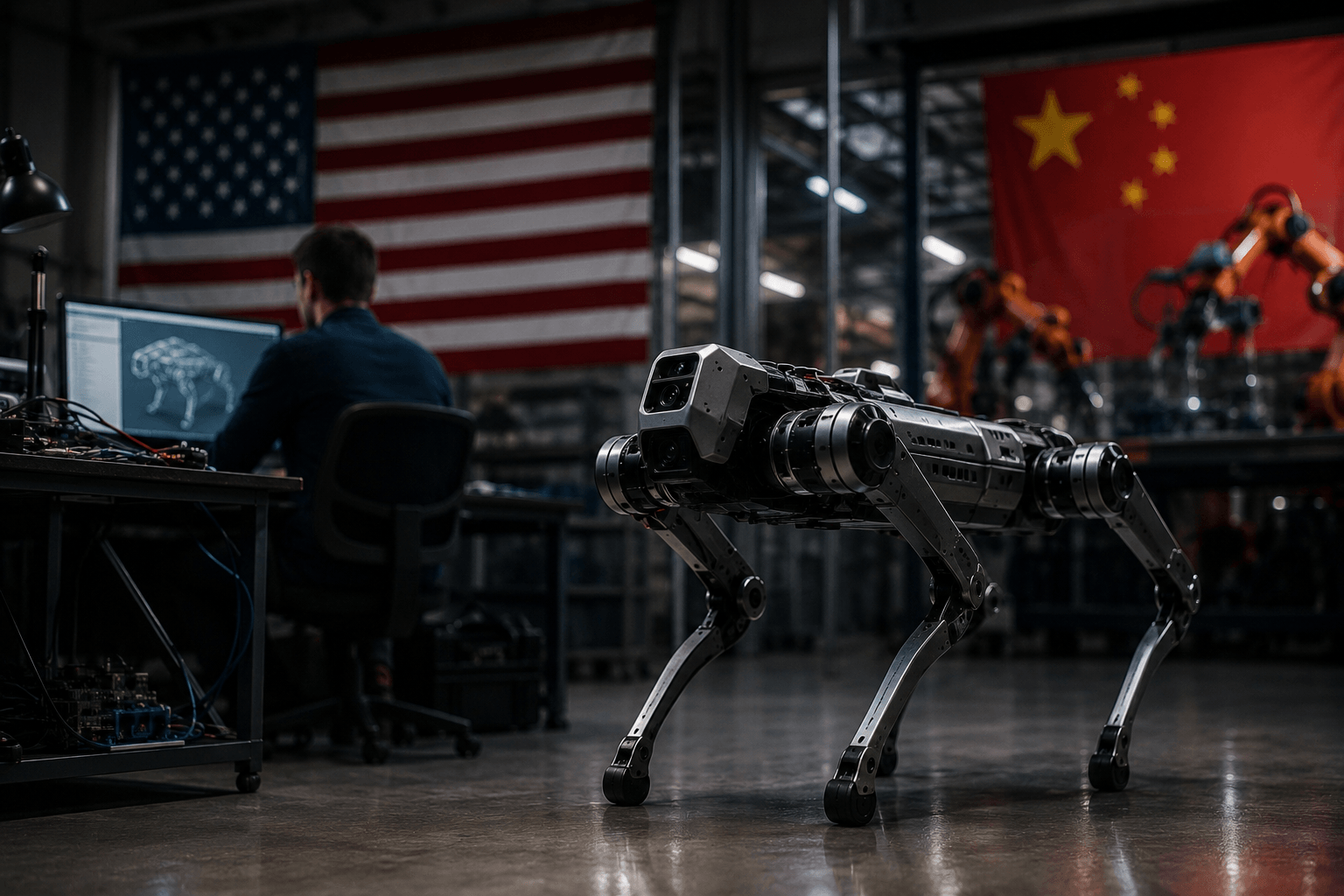
A strange thing is happening in the global technology race.
Some of the research that helped advance China’s rapidly growing robot-dog industry was funded by the U.S. military.
That does not mean China stole American military technology. The underlying research was deliberately published openly so that scientists and engineers around the world could build upon it.
The more important lesson is what happened afterward.
China proved highly effective at turning publicly available research into inexpensive, commercially scalable hardware.
That makes this story about much more than robot dogs.
It is about the growing importance of manufacturing capacity in determining technological power.
From Military Research to Commercial Robots
The story begins with U.S.-funded robotics research conducted at institutions including MIT and the University of Pennsylvania, with support from organizations such as the U.S. Army Research Laboratory and DARPA.
One important project produced Mini Cheetah, a quadruped robot designed to improve robotic movement, agility and mobility.
The research was openly published.
That was intentional. The objective was to advance robotics by allowing researchers throughout the world to study and build upon the findings.
Years later, Chinese robotics company Unitree Robotics developed commercial quadruped robots whose dimensions and design characteristics closely resemble technologies developed through this research.
Researchers involved in the original work told Reuters that some of the dimensions of Unitree’s Go2 robot were remarkably similar to those of the Mini Cheetah.
But the important question is not whether Unitree had access to the research.
It did.
The research was public.
The important question is what Unitree was able to do with it.
China Turned Research Into a Product
Unitree combined advances in robotics with China’s enormous manufacturing ecosystem.
The result was a robot that could be produced at a price far below many competing Western systems.
Its Go2 quadruped robot has been sold for around $1,600, helping move robot dogs beyond research laboratories and into a much broader commercial market.
Unitree has since become one of the world’s most prominent robotics companies, selling both quadruped and humanoid robots.
According to company filings cited by Reuters, Unitree sold approximately 18,000 quadruped robots and 5,500 humanoid robots in the previous year.
The company is also moving toward becoming a publicly traded enterprise, with its Shanghai listing attracting enormous investor interest.
The significance is clear.
A technology that began as advanced academic research has become part of a commercially scalable Chinese industry.
The Difference Between Inventing and Industrializing
This is where the story becomes strategically important.
The United States remains one of the world’s leading sources of robotics research.
It has universities, laboratories, technology companies and enormous amounts of venture capital capable of producing advanced prototypes.
But building a successful physical technology requires another capability:
manufacturing at scale.
A robot needs motors.
It needs batteries, sensors, circuit boards, actuators, gears and mechanical components.
It needs factories capable of producing those components consistently and cheaply.
And it needs an ecosystem capable of rapidly improving the product while reducing its cost.
China possesses many of those capabilities in enormous depth.
That gives Chinese robotics companies an important advantage once technology moves from the laboratory into the factory.
This Is Not a Story About Technology Theft
The distinction matters.
The U.S.-funded robotics research at the center of the story was not secretly transferred to China.
It was published openly.
Researchers believed that sharing their work would accelerate scientific progress.
The problem therefore isn’t that the United States shared something it should have kept secret.
The problem is that open scientific knowledge can benefit whichever country has the strongest ability to commercialize it.
That creates a different kind of strategic competition.
The country that invents a technology does not necessarily become the country that dominates its industry.
China’s Manufacturing Ecosystem Changes the Equation
China’s robotics advantage is connected to a much larger industrial structure.
The country has spent years developing manufacturing capabilities across:
- electronics,
- batteries,
- motors,
- sensors,
- precision components,
- industrial machinery,
- artificial intelligence hardware.
Those capabilities can be reused across industries.
The same manufacturing ecosystem that supports electric vehicles, drones and consumer electronics can also support robotics.
This allows companies to experiment quickly, manufacture at scale and reduce costs.
That combination can transform an expensive research technology into a mass-market product.
The Strategic Importance of Embodied AI
Robot dogs are only one part of a much larger technological shift.
Artificial intelligence is increasingly moving from screens and data centers into physical machines.
This emerging field—often described as embodied AI—includes:
- humanoid robots,
- autonomous drones,
- industrial robots,
- warehouse robots,
- autonomous vehicles,
- robotic logistics systems.
These machines combine AI models with sensors, motors and physical systems.
That makes their development fundamentally different from software.
A software model can be copied and distributed almost instantly.
A robot cannot.
It has to be manufactured.
That means industrial capacity becomes part of AI capability.
The Military Dimension
The technology is also attracting increasing attention from defense organizations.
Chinese state media has shown Unitree quadruped robots operating alongside People’s Liberation Army personnel, including demonstrations involving armed systems.
That does not mean commercial Unitree robots are themselves military weapons.
But the underlying technologies—autonomous navigation, balance, terrain movement, computer vision and robotic control—have obvious dual-use applications.
A robot capable of moving independently across difficult terrain has potential applications in logistics, surveillance, reconnaissance and other military missions.
This is why Washington has increasingly treated advanced robotics as a national-security issue.
Washington Is Starting to Respond
The United States has already taken steps against the growing presence of Chinese robotics technology.
In June, the Pentagon added Unitree to its list of companies considered contributors to China’s defense industrial base.
That designation does not amount to a comprehensive economic sanctions regime, but it signals that Washington sees the company as strategically relevant.
The U.S. government has also moved toward restricting imports of new Chinese humanoid and quadruped robots.
The logic is straightforward.
If advanced robotics becomes strategically important, Washington does not want critical parts of the emerging industry to become dependent on Chinese manufacturers.
But restrictions alone cannot solve the underlying problem.
Blocking Chinese robots does not automatically create American factories capable of producing cheaper alternatives.
The Real Challenge Is Commercialization
This is perhaps the most important lesson from the entire development.
America has demonstrated that it can produce world-class robotics research.
China has demonstrated that it can take technology from the research stage to mass production.
Those are two different capabilities.
The first produces inventions.
The second creates industries.
And as technologies such as robotics become strategically important, the second capability may become just as important as the first.
The United States therefore faces a broader question than whether it can develop the next breakthrough.
It needs to determine whether it can build the industrial ecosystem required to manufacture that breakthrough competitively.
A Familiar Pattern
The robotics industry is not an isolated case.
A similar debate has emerged around other technologies.
In solar panels, China became the dominant manufacturing power after years of technological development involving companies and researchers around the world.
Electric vehicles followed a similar path, with Chinese companies building enormous production capacity and supply chains.
Drones provide another example of how manufacturing scale can translate into technological and strategic influence.
Robotics could become the next major example.
The critical advantage may not belong exclusively to the country that invents the technology.
It may belong to the country that can manufacture it faster, cheaper and at greater scale.
The Strategic Question Is Changing
For decades, technological competition was often described as a race to invent.
Who develops the better semiconductor?
Who creates the better AI model?
Who builds the more advanced robot?
Those questions remain important.
But the robotics story introduces another question:
Who can actually manufacture the technology?
That question is becoming increasingly important because the next generation of strategic technologies will not exist only in laboratories or data centers.
They will operate in the physical world.
They will require factories, supply chains, materials and skilled workers.
And that means the boundary between technology policy and industrial policy is becoming increasingly difficult to define.
The Bigger Lesson
The irony of the robot-dog story is that the United States did not necessarily lose because its researchers failed.
In some ways, the opposite is true.
American researchers helped push robotics forward.
Their work was important enough to become part of the global knowledge base.
China then demonstrated how effectively that knowledge could be combined with manufacturing scale and commercial execution.
That distinction matters.
The future technological balance between the United States and China may depend not only on who makes the next breakthrough, but on who can turn breakthroughs into affordable, mass-produced systems first.
The robot dog is therefore only the visible part of a much larger competition.
The deeper contest is between research capability and industrial capability—and increasingly, between the two together.