As the race to build artificial intelligence infrastructure accelerates, the semiconductor industry’s biggest challenge is no longer limited to manufacturing chips. Designing increasingly complex processors and networking technologies has become just as critical.
That shift helps explain why U.S. semiconductor company Marvell Technology has announced plans to invest $250 million in India over the next three years and double its workforce in the country.
The investment will expand the company’s engineering and research capabilities, including a new wing at its Bengaluru campus and a larger presence in Hyderabad. According to Marvell, the expansion will support the development of semiconductor technologies for artificial intelligence, cloud computing, and data infrastructure.
Rather than increasing manufacturing capacity, the announcement is about increasing the company’s ability to design the technologies that power modern data centers.
Investing in Engineering, Not Manufacturing
The announcement is notable for what it does—and what it does not.
Marvell is not building a semiconductor fabrication plant in India. It is not relocating chip manufacturing or establishing a new production line. Instead, the company is investing in research facilities, engineering talent, and product development.
Marvell operates as a fabless semiconductor company, meaning it designs chips while outsourcing manufacturing to specialized foundries such as TSMC. As a result, expanding its business often means hiring more engineers rather than constructing new factories.
The $250 million investment is therefore aimed at strengthening the design side of the semiconductor value chain, where engineers develop the processors, networking chips, storage controllers, and custom silicon used in AI systems before they are manufactured elsewhere.
Why India?
India has quietly become one of the world’s largest centers for semiconductor design.
Over the past two decades, many of the industry’s leading companies—including NVIDIA, AMD, Qualcomm, Intel, Texas Instruments, Synopsys, and Cadence—have established large engineering operations in the country. These centers contribute to chip architecture, verification, software integration, and hardware development for products sold globally.
Several factors have driven this trend. India offers a large pool of experienced semiconductor engineers, competitive development costs, and an expanding ecosystem supported by government initiatives to strengthen the country’s semiconductor industry.
For companies like Marvell, whose growth depends heavily on engineering capacity, India represents an opportunity to expand product development without the enormous capital requirements associated with building manufacturing facilities.
The AI Infrastructure Opportunity
The timing of Marvell’s announcement is closely linked to the rapid expansion of artificial intelligence infrastructure.
Training and deploying modern AI models requires vast networks of specialized hardware. While graphics processors receive most of the attention, AI data centers also depend on high-speed networking chips, storage controllers, optical connectivity, and custom silicon that move enormous volumes of data efficiently between servers.
Marvell has become an important supplier in these segments. Its products are designed to improve how data flows inside AI infrastructure, making networking and connectivity as important as computing power itself.
As demand for AI hardware continues to grow, expanding engineering teams allows the company to accelerate the development of new products and shorten the time required to bring increasingly complex semiconductor designs to market.
A Different Kind of Semiconductor Investment
Much of the global discussion around semiconductors has focused on building fabrication plants. Governments in the United States, Europe, Japan, South Korea, and India have introduced policies aimed at increasing domestic manufacturing capacity and reducing dependence on a handful of overseas producers.
Marvell’s investment highlights another part of the semiconductor ecosystem that receives less attention.
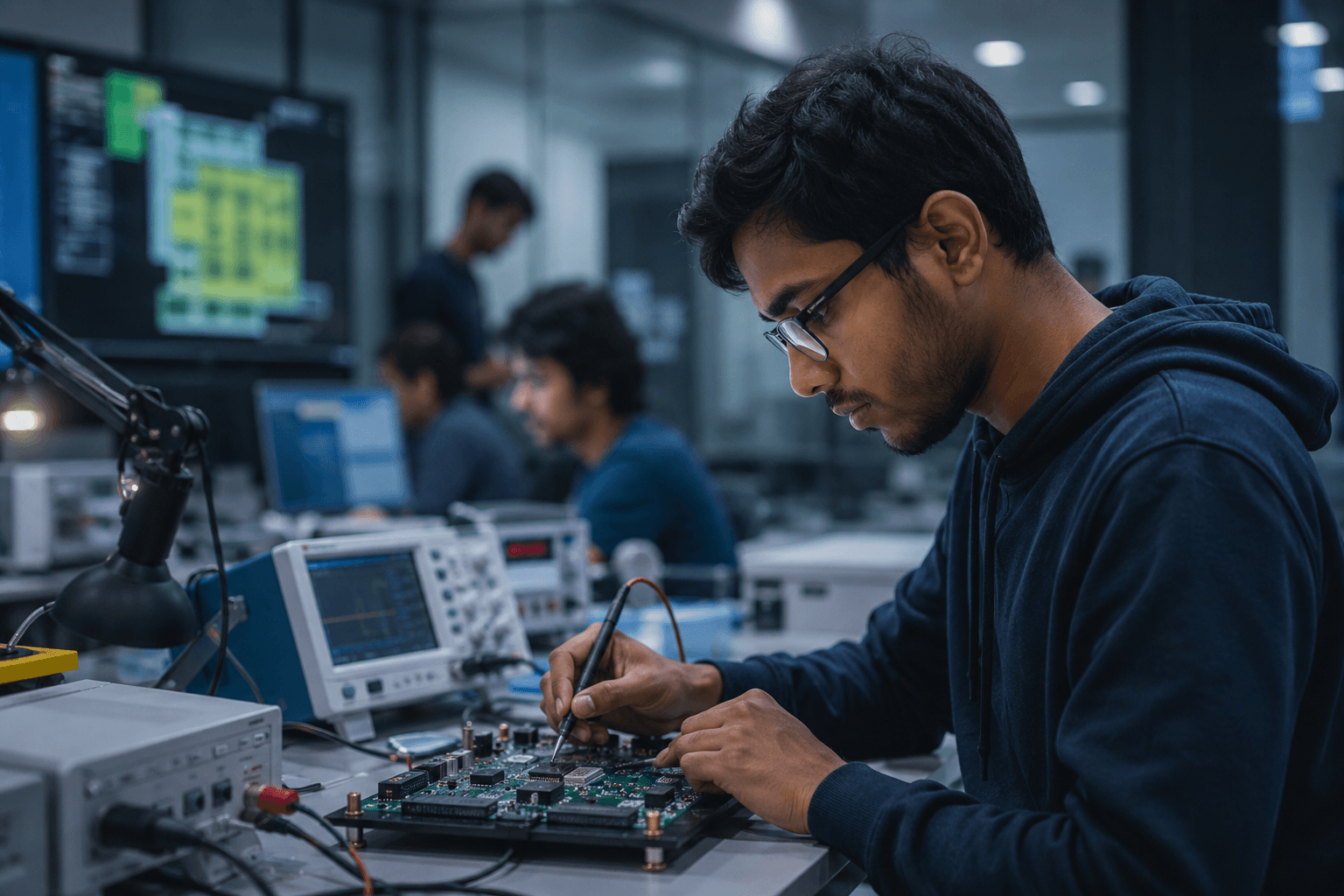
Every advanced chip begins with years of engineering work before it reaches a manufacturing facility. Designing increasingly sophisticated semiconductor architectures requires thousands of highly skilled engineers working across hardware, software, verification, and system integration.
By expanding its engineering operations rather than manufacturing capacity, Marvell is investing in the stage of the value chain where many of the industry’s current bottlenecks are emerging.
What It Means for India
For India, the announcement reinforces the country’s growing position as a global semiconductor design hub.
The investment does not immediately increase India’s domestic chip manufacturing capability, nor does it establish a new fabrication plant. Instead, it strengthens one of the country’s existing competitive advantages: engineering talent.
As more global semiconductor companies expand their research and design operations in India, the country is becoming increasingly integrated into the industry’s highest-value activities. This complements India’s broader strategy of building a more complete semiconductor ecosystem that includes design, packaging, manufacturing, and electronics production.
While manufacturing remains concentrated in countries such as Taiwan, South Korea, and the United States, India is steadily becoming a larger contributor to the intellectual and engineering work behind next-generation semiconductor technologies.
Beyond One Company’s Expansion
Marvell’s announcement is more than a corporate hiring plan. It reflects how the economics of the semiconductor industry are evolving in the age of artificial intelligence.
The industry’s competitive advantage is no longer determined solely by who can manufacture the most advanced chips. It increasingly depends on who can design them faster, improve networking and data movement, and recruit the engineering talent needed to keep pace with rapidly changing AI workloads.
Marvell’s $250 million investment is a recognition of that reality. By expanding its engineering footprint in India, the company is strengthening a capability that has become as strategically important as manufacturing itself. At the same time, the announcement underscores India’s emergence as a key center for semiconductor innovation, where global companies are choosing to build the expertise behind the next generation of AI infrastructure rather than the factories that produce it.