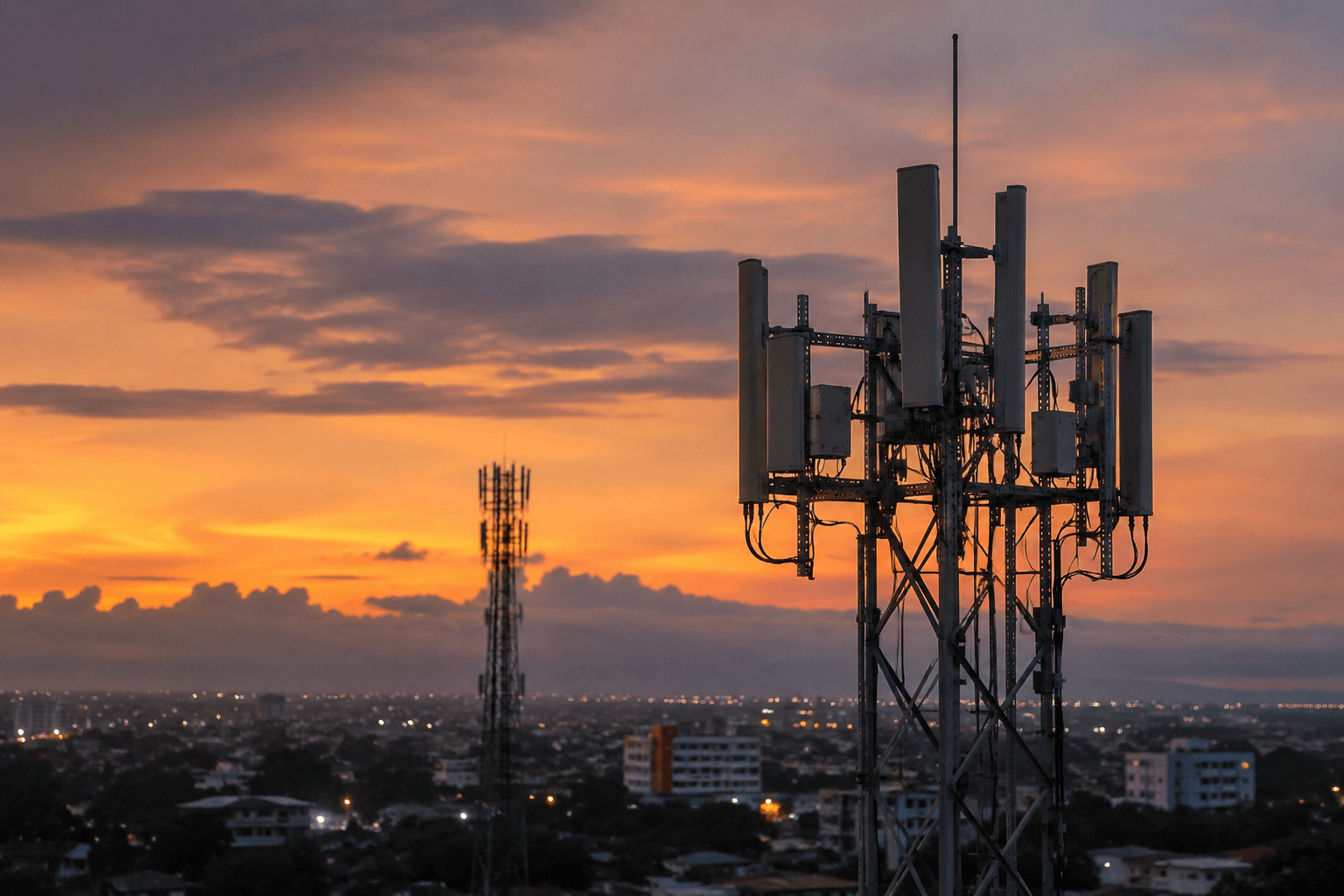
For wireless carriers, competing is no longer just about attracting more subscribers. It is increasingly about owning the infrastructure needed to carry ever-growing volumes of data.
That is why spectrum has become one of the industry’s most valuable assets.
AT&T has now taken one of its biggest steps in that direction by completing its $23 billion acquisition of wireless spectrum licenses from EchoStar, closing a deal first announced in August 2025. The transaction gives AT&T approximately 50 MHz of additional spectrum across virtually every market in the United States, strengthening the foundation of its nationwide wireless network as demand for high-speed connectivity continues to grow.
The deal follows regulatory approval from the U.S. Federal Communications Commission (FCC) earlier this year and marks one of the largest spectrum transactions in the country’s telecommunications industry.
Why Spectrum Matters
Every mobile network depends on three essential resources: towers, fiber, and radio spectrum.
Among them, spectrum is the scarcest.
Unlike network equipment, spectrum cannot be manufactured or easily expanded. Governments allocate radio frequencies, making them a finite national resource that wireless operators compete to acquire.
Without sufficient spectrum, carriers eventually face limits on how much data their networks can carry, regardless of how many cell towers they build or how advanced their equipment becomes.
As mobile usage grows and applications such as artificial intelligence, cloud computing and connected devices consume more bandwidth, owning additional spectrum has become a long-term strategic advantage.
What AT&T Is Acquiring
The transaction provides AT&T with a combination of low-band and mid-band spectrum, each serving a different purpose within a wireless network.
The acquisition includes 20 MHz of 600 MHz low-band spectrum, which travels longer distances and penetrates buildings more effectively. These frequencies are particularly valuable for expanding rural coverage and improving indoor connectivity.
It also includes 30 MHz of 3.45 GHz mid-band spectrum, widely regarded as one of the most important frequency ranges for modern 5G networks. Mid-band spectrum offers significantly higher capacity and faster data speeds while still providing broad geographic coverage, making it well suited for densely populated urban areas.
Together, these assets give AT&T additional flexibility to improve both the reach and performance of its wireless network.
Why EchoStar Sold the Spectrum
The sale is part of EchoStar’s broader financial and operational restructuring.
Over the past year, the company has faced mounting financial pressure alongside regulatory scrutiny over how quickly it was deploying parts of its wireless spectrum portfolio.
Selling a portion of those assets allowed EchoStar to raise capital while resolving regulatory issues surrounding underutilized spectrum holdings.
The transaction was one component of a broader restructuring that also included separate spectrum transactions approved by the FCC earlier this year.
A Different Kind of Competition
For much of the mobile industry’s history, competition largely revolved around attracting new subscribers.
Today, the largest U.S. carriers already serve hundreds of millions of customers, leaving relatively little room for rapid customer growth.
Increasingly, competition is shifting toward network quality.
Faster speeds, greater capacity, stronger coverage and improved reliability have become the primary ways operators distinguish themselves. Acquiring additional spectrum directly supports each of those objectives, particularly as data traffic continues to increase.
For AT&T, the transaction strengthens its position alongside Verizon and T-Mobile, both of which have also invested heavily in expanding their spectrum portfolios during the rollout of 5G.
What This Means for the Industry
The significance of the deal extends beyond AT&T itself.
Telecommunications companies are preparing for a future in which wireless networks support far more than smartphones. Artificial intelligence applications, connected vehicles, industrial automation, cloud services and fixed wireless broadband are all expected to place increasing demands on mobile infrastructure.
Meeting that demand will depend not only on deploying new equipment but also on securing enough spectrum to carry future traffic.
In that sense, spectrum is no longer simply a regulatory license. It has become one of the industry’s most important strategic assets.
The completion of AT&T’s acquisition does not immediately change the experience of mobile users. Integrating new spectrum into a nationwide network takes time, and improvements in coverage and capacity will emerge gradually.
What the deal does change is AT&T’s long-term capability.
As the telecommunications industry moves beyond the initial rollout of 5G and prepares for the next generation of digital services, ownership of scarce spectrum is becoming a decisive competitive advantage. AT&T’s $23 billion investment reflects that reality, highlighting how the future of wireless competition is increasingly being shaped not by who has the most customers, but by who controls the infrastructure that powers the network behind them.