Most people will read this story as a layoff announcement.
It isn’t.
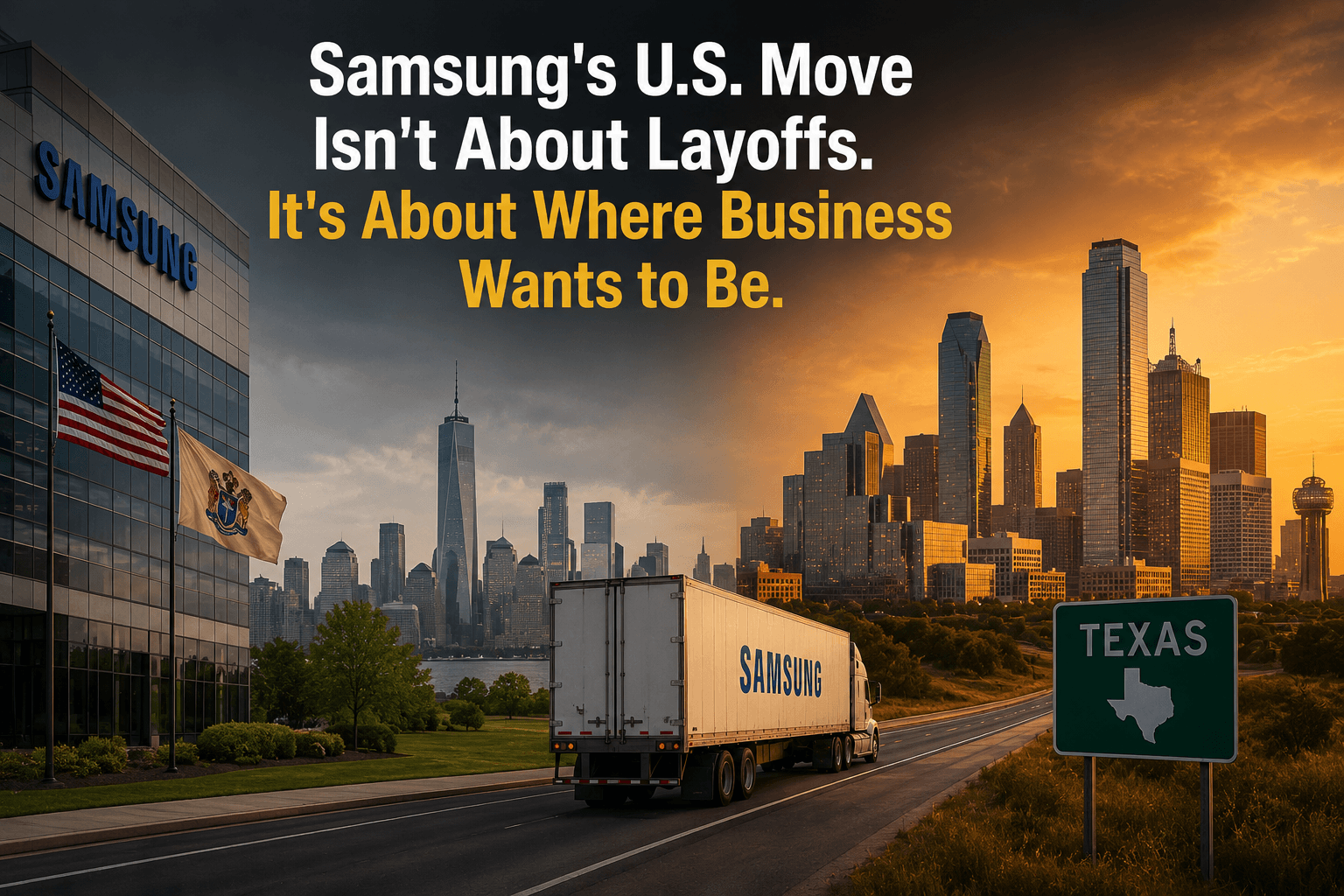
Samsung Electronics America is cutting hundreds of positions in New Jersey as it prepares to move its U.S. headquarters to Texas. Some employees have been offered relocation, while others will leave the company.
The headlines focus on the jobs.
The bigger story is the geography.
For decades, companies chose headquarters based on where they sold products or where executives preferred to live.
Today, they increasingly choose locations based on where the ecosystem already exists.
An ecosystem is more than office space.
It includes engineers, suppliers, manufacturers, universities, logistics networks, investors, regulators, and even competing companies. The closer these pieces are to one another, the faster ideas, talent, and products move.
Businesses no longer compete alone.
They compete as part of ecosystems.
Texas has spent years building one of those ecosystems.
Major semiconductor manufacturers have invested tens of billions of dollars in the state. AI infrastructure companies are expanding there. Electronics manufacturing continues to grow, and the state has attracted corporate headquarters from industries ranging from technology to finance.
Samsung itself has already committed major investments in semiconductor manufacturing in Texas.
Moving its consumer electronics headquarters closer to that broader footprint follows the same logic.
Instead of spreading operations across distant offices, companies increasingly bring leadership, engineering, and operations closer together.
This isn’t unique to Samsung.
Apple has expanded engineering operations in Austin.
Tesla moved its headquarters to Texas.
Oracle relocated there.
Many manufacturers have followed similar paths, drawn by lower operating costs, business-friendly policies, growing technical talent, and access to infrastructure.
The shift isn’t simply about taxes.
It’s about concentration.
The more companies cluster together, the more valuable the cluster becomes.
Economists call this agglomeration—the tendency for businesses, workers, suppliers, and institutions to become more productive when they are located near one another.
Silicon Valley became powerful because of this.
Shenzhen became the world’s electronics capital because of this.
Taiwan’s semiconductor industry grew because companies, suppliers, universities, and skilled workers formed an ecosystem that reinforced itself over decades.
Texas is attempting to build a similar advantage across advanced manufacturing and technology.
These decisions also reveal how companies now think about headquarters.
A headquarters is no longer just where executives work.
It increasingly functions as the coordination center for engineering, manufacturing, supply chains, and strategic decision-making.
As supply chains become more complex and product cycles become shorter, reducing the distance between those functions creates real competitive advantages.
Every mile removed from suppliers, factories, and engineering teams adds friction.
Businesses try to remove friction wherever they can.
The story also reflects a broader trend in the global economy.
Competition is shifting away from individual companies and toward regions.
Countries are competing to build semiconductor ecosystems.
States are competing to attract AI infrastructure.
Cities are competing for research talent and advanced manufacturing.
Success increasingly depends on creating environments where businesses want to stay—not just arrive.
Samsung’s workforce changes are the immediate headline.
The more important story is what they reveal.
When companies relocate today, they aren’t simply changing addresses.
They’re choosing which economic ecosystem they believe will matter most over the next decade.
And in a world where technology, manufacturing, and AI are becoming more interconnected, location is becoming a competitive advantage in its own right.