Introduction
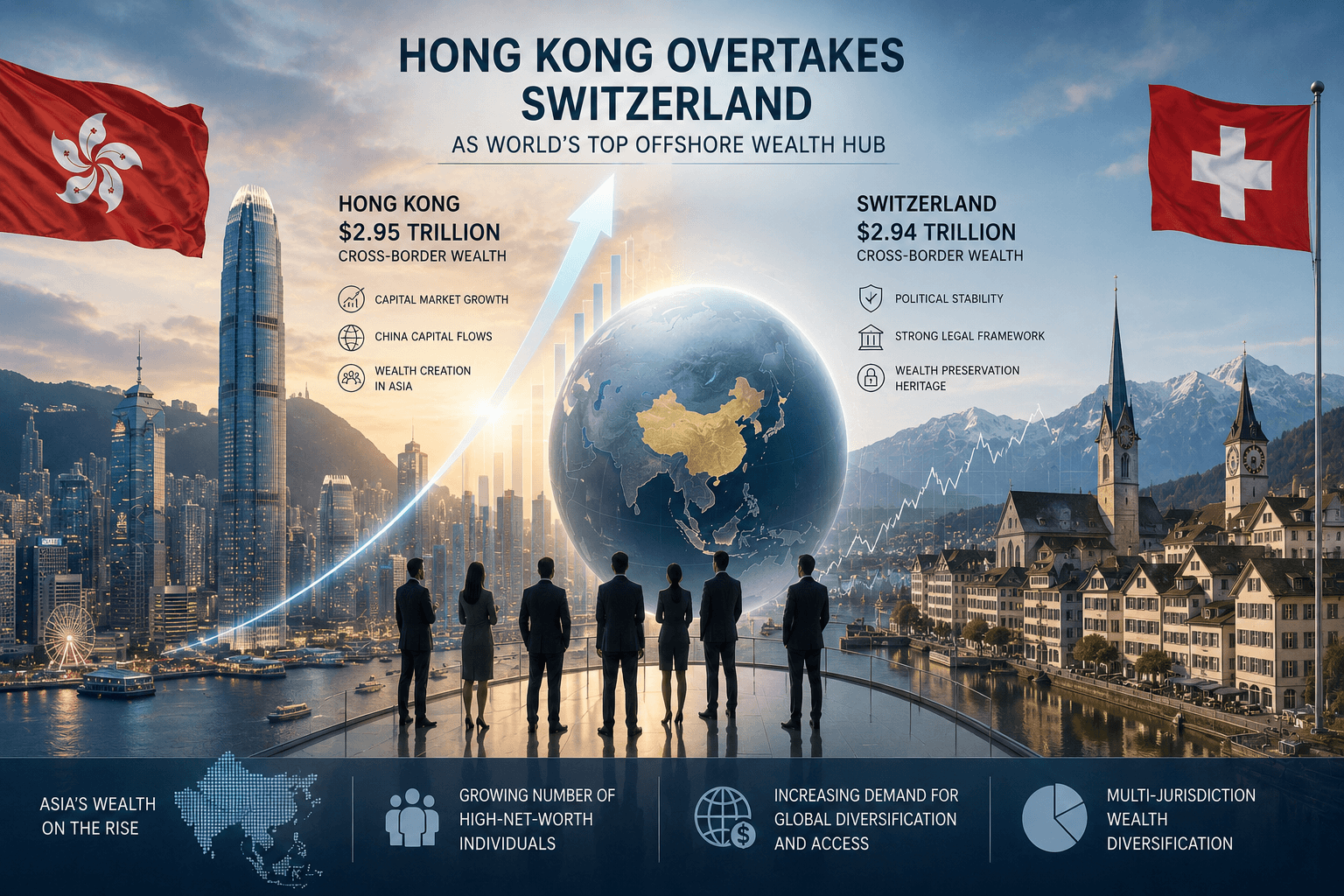
Hong Kong has overtaken Switzerland as the world’s largest offshore wealth hub, marking a major shift in global private banking and cross-border asset management.
The development was highlighted in the latest Global Wealth Report published by Boston Consulting Group (BCG) in May 2026. According to the report, Hong Kong now manages slightly more cross-border wealth than Switzerland, ending decades of Swiss leadership in the sector.
The change reflects the rapid growth of wealth in Asia, particularly mainland China, and Hong Kong’s expanding role as a gateway to international financial markets.
Hong Kong Surpasses Switzerland in Offshore Wealth
BCG estimates that Hong Kong currently manages around $2.95 trillion in offshore or cross-border wealth assets, narrowly ahead of Switzerland’s $2.94 trillion.
Cross-border wealth refers to assets held outside an individual’s home country through international private banks, investment firms, and wealth management structures. These assets are commonly used for diversification, international investment access, and estate planning.
Hong Kong’s rise has been driven largely by capital from mainland China. Wealthy Chinese individuals and businesses continue to use the city’s financial system to access global markets, dollar-based assets, and international investment products.
The city has also benefited from stronger equity market activity and renewed IPO momentum over the past year, supporting higher inflows into wealth management services.
Switzerland, meanwhile, remains one of the world’s most established private banking centers. Swiss financial institutions continue to attract international clients seeking political stability, legal protections, and long-term wealth preservation.
Why the Shift Matters
Hong Kong’s rise reflects a broader shift in the global distribution of wealth and financial influence.
Asia has become one of the fastest-growing regions for high-net-worth individuals, supported by expanding business activity, technology investment, and deeper capital markets. Financial hubs such as Hong Kong and Singapore are playing a larger role in global wealth management as a result.
The development also highlights how wealthy investors are increasingly diversifying assets across multiple jurisdictions amid geopolitical uncertainty and changing global capital flows.
Conclusion
Hong Kong’s move ahead of Switzerland represents a significant milestone for the global financial industry. Although the difference remains narrow, the shift underlines the growing importance of Asian financial markets in international wealth management while reinforcing Hong Kong’s position as a leading global finance center.