Introduction
Researchers from Stanford University and SkyWater Technology have unveiled a new monolithic 3D AI chip architecture designed to improve performance and energy efficiency for artificial intelligence workloads.
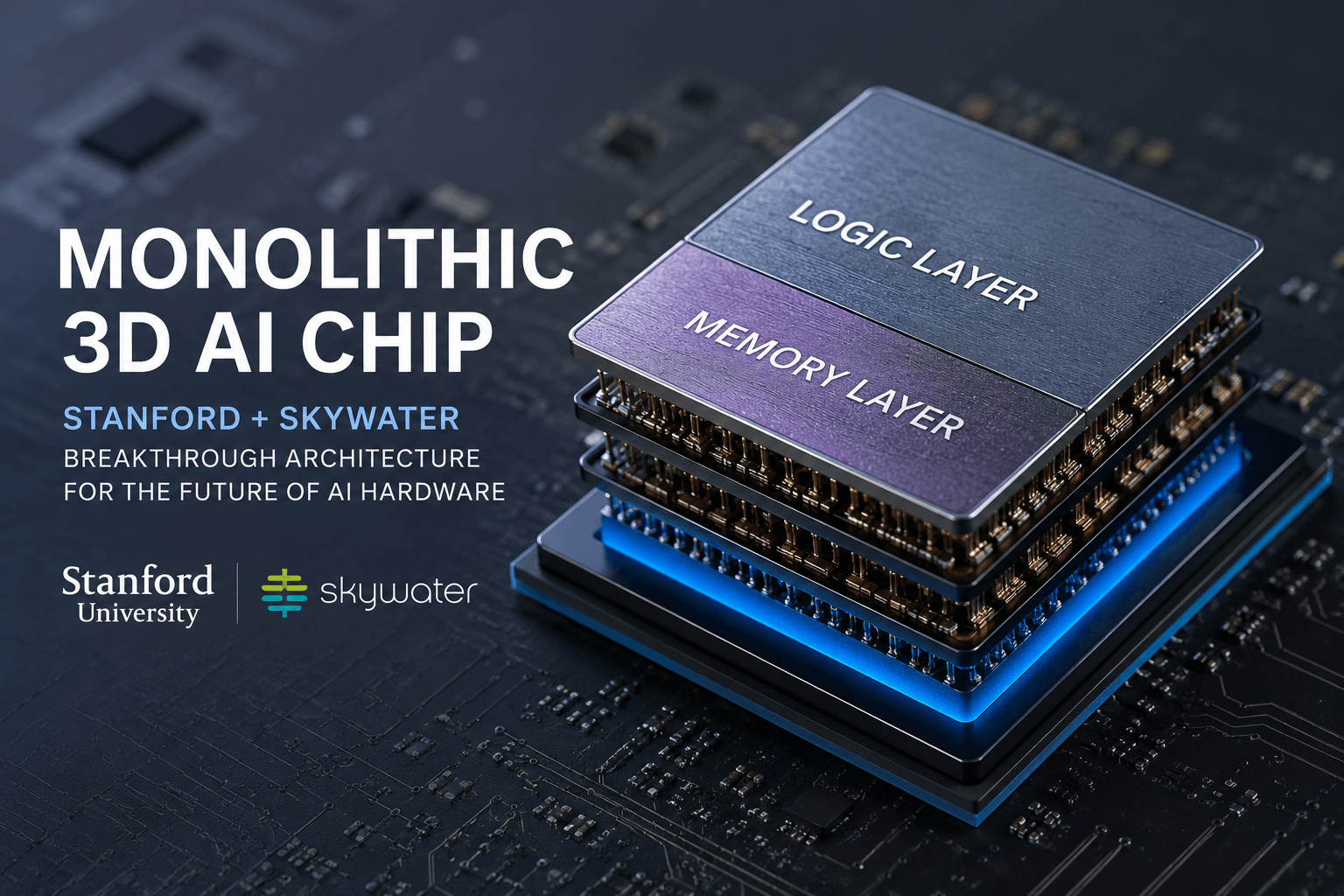
The breakthrough focuses on vertically stacking memory and computing layers within a single chip, helping reduce data transfer delays and one of AI computing’s biggest challenges: power-hungry memory movement.
Main News Details
The new monolithic 3D AI chip uses a manufacturing approach that builds multiple transistor layers directly on top of each other instead of placing chip components side-by-side. By positioning memory and logic closer together, the architecture improves bandwidth and reduces energy consumption during AI processing.
According to the research team, the design is especially well-suited for AI inference and machine learning applications, where moving large amounts of data between processors and memory often limits performance.
SkyWater worked with Stanford researchers to manufacture the prototype using advanced semiconductor fabrication techniques. The project also highlights the semiconductor industry’s growing push toward 3D chip architectures as traditional transistor scaling becomes increasingly difficult and expensive.
Researchers said the technology could eventually support denser AI accelerators, more efficient edge AI devices, and faster data center hardware.
Why the Breakthrough Matters
As AI models continue to grow in size and complexity, chipmakers are facing rising challenges around heat, energy consumption, and memory bottlenecks. Monolithic 3D integration offers a potential solution by improving communication between compute and memory layers without requiring entirely new computing methods.
The collaboration is notable because it combines university-led research with commercial semiconductor manufacturing expertise, potentially helping the technology move more quickly toward real-world deployment.
The announcement also reflects a wider industry trend toward advanced packaging and vertically stacked chip designs aimed at sustaining AI performance growth beyond traditional Moore’s Law improvements.
Conclusion
The Stanford and SkyWater partnership marks an important step in next-generation AI hardware development. While the technology is still in its early stages, monolithic 3D AI chips could play a major role in building faster and more energy-efficient processors for future AI systems.